A Western Washington guide to the Aug. 5 primary election
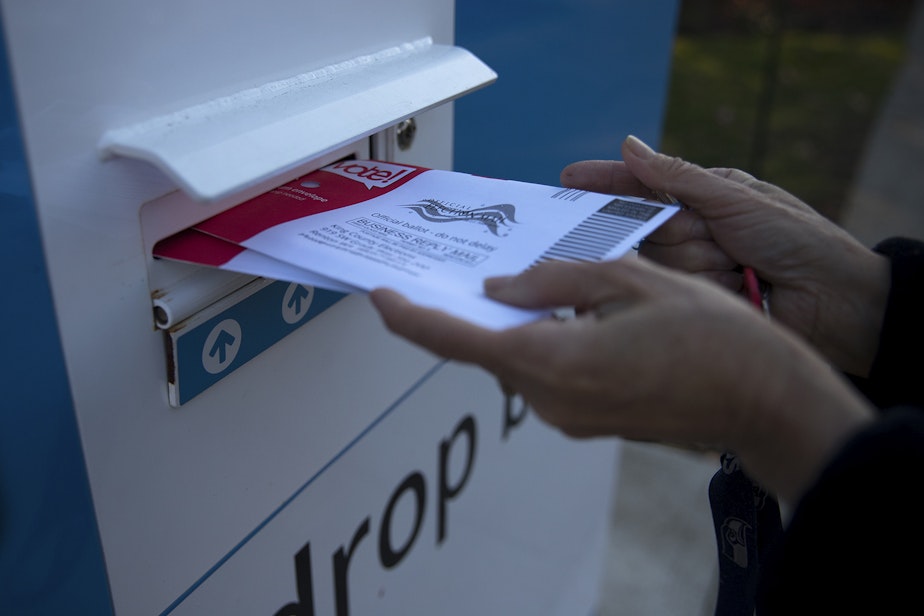

Washington state voters likely have received their ballots in the mail for this summer primary election season.
The top two vote-getters in each race will advance to the November election. But before that happens, there are some trends to look out for.
Will Seattle's city government swing to the left or remain centrist? Are legislative Democrats' recent tax hikes going to backfire on them? Could frustration over Seattle schools' messy budget reshape its board of directors?
Here's a roundup of what western Washington voters should know about the Aug. 5 ballot.
King County
King County Executive
King County executive is a little-known but important job overseeing the metro bus system, county jail, drug and mental health treatment, and wastewater departments. The executive manages around 17,000 employees — more than the state government of Alaska — and a budget that’s in deep trouble. Declining tax revenues mean big cuts are probably coming this year.
With the executive seat open for the first time in 16 years, two prominent Democrats have emerged as frontrunners: County Councilmember Girmay Zahilay, who represents the south end of Seattle and the county and has raised nearly $900,000, and County Councilmember Claudia Balducci, who represents the Eastside and has raised a little over $660,000.
Five other candidates, including GOP-endorsed Derek Chartrand, have raised far less. County assessor John Arthur Wilson will also appear on the ballot, but Wilson canceled his campaign this month after he was arrested outside the Seattle home of his ex-fiancee, who has a restraining order against him.
Sponsored
Seattle Mayor
Seattle Mayor Bruce Harrell is trying to win a second term, something a sitting mayor hasn’t done in 20 years. Of the seven people running against him, progressive activist Katie Wilson is the front-runner, having matched Harrell’s $450,000 in fundraising.
Harrell, an establishment moderate with endorsements from the governor and state attorney general, touts his policy of encampment removals to reduce visible homelessness.
Wilson — whom The Nation and The Urbanist compare to New York City mayoral frontrunner and Democratic Socialist Zohran Mamdani — points out that the number of unhoused people actually increased under Harrell.
On public safety, Wilson says police hiring hasn’t kept pace with the city’s need for more cops, though Harrell counters that hiring is finally increasing. He’s also slammed Wilson over her 2020 support for slashing the police budget. Wilson, in response, says she doesn’t plan to defund the police.
Sponsored
Among Harrell’s other challengers, top fundraisers include former T-Mobile executive Joe Mallahan, and actor Ry Armstrong.
Seattle City Attorney
Though this position is nonpartisan, City Attorney Ann Davison’s affiliation with the Republican Party has become a central issue in her run for reelection. Davison has spoken out against some of President Donald Trump's policies but insists that party is irrelevant in the race and instead points to her work on local issues — like ordinances she backed to keep individuals with drug and prostitution-related charges from entering certain zones of the city.
Davison’s opponents say she’s been too punitive. And they’re banking on the GOP’s unpopularity in Seattle.
Erika Evans, who’s raised about as much as Davison ($220,000), calls the incumbent “disgraceful” for joining the Republican Party. Evans recently left her job as a federal prosecutor shortly after Trump returned to the White House.
Sponsored
Also running for this office are King County public defender Nathan Rouse and legal aid attorney Rory O’Sullivan.
Seattle City Council District 2
What a year it’s been in District 2. In December, Tammy Morales announced she was quitting the council. In January, Mark Solomon was appointed to the vacant District 2 seat, which covers the Chinatown-International District and South Seattle. He isn’t running to keep the job, so there will be four new names on the August primary ballot for D2: Jeanie Chunn, Adonis Ducksworth, Jamie Fackler, and Eddie Lin.
Ducksworth, Mayor Harrell’s transportation policy manager, is one of the top fundraisers and recently nabbed an endorsement from The Seattle Times. His top concern for the district is gun violence.
Lin is also a top fundraiser in this race. He’s an assistant attorney for the city and an advocate for denser housing. He earned The Stranger’s endorsement.
Sponsored
Whoever wins in D2 this year will serve out the remainder of Morales’ term — there will be another election for this seat in 2027.
Seattle City Council Position 8
Incumbent Alexis Mercedes Rinck, viewed as the most progressive voice on a council packed with business-friendly centrists, is running to keep her citywide seat. She won an election last November, beating council appointee Tanya Woo, who was named to the position in January 2024, after Teresa Mosqueda won a seat on the King County Council in 2023.
This year is part of the normal election cycle for Position 8, so whoever wins will serve a regular four-year term.
Rinck has vastly out-fundraised her opponents. Her $200,000 dwarfs that of her opponents, Rachael Savage ($5,000), Ray Rogers ($4,400), and Cooper Hall ($2,000).
Sponsored
Rinck recently teamed up with Mayor Harrell to propose a revamp of Seattle’s business and occupation tax. They say the change, which would see large companies pay more, could help ease a yawning budget gap and prepare for cuts from the Trump administration, though business leaders fear the measure is half-baked.
Seattle City Council Position 9
Seattle City Council President Sara Nelson is seeking reelection to her citywide seat. Her moderate policies have drawn ire from the progressive left — including approving raises and hiring bonuses for Seattle cops and opposing a local capital gains tax on the city’s richest residents. Her bid for reelection, like those of Mayor Harrell and City Attorney Davison, could signal whether city voters want their government to continue on the centrist path it’s been on the last few years.
Nelson has raised $422,000 in her race so far. Her next closest competitor, Dionne Foster, has $271,000 in her campaign coffers. Foster heads up the advocacy group Progress Alliance of Washington and helped pass the state’s capital gains tax in 2021. The Stranger has reported that Foster supports a local wealth tax as a source of progressive revenue for the city, but The Seattle Times says Foster merely seems open to the idea. Foster has also voiced support for both hiring more cops and providing more policing alternatives.
Seattle Prop. 1: Democracy vouchers levy
Every local election, Seattle voters get something in the mail that no other voters in America do: vouchers for $100 each, to donate to any local candidate for office. In the 10 years the Democracy Vouchers program has been around, advocates and experts say it’s expanded the number and type of people who give to candidate campaigns from a tiny sliver of rich waterfront dwellers to a group that looks more like Seattle as a whole.
It’s also cheap: If approved, the new slightly higher tax would cost the median homeowner in Seattle $12.20 a year.
Detractors argue that only a small share of the voting-age population in Seattle use this program. (Usage fell to less than 5% in 2023 after an all-time high of 7.59% in 2021.) Critics also say the program hasn’t delivered on promises to keep big money out of politics, pointing out that rich supporters can spend unlimited amounts of money via “independent expenditure” campaigns.
King County Prop. 1: Parks levy
King County voters will decide whether to renew a property tax to fund improvements and maintenance to hundreds of county parks and trails. The current levy expires at the end of this year — the county’s new Proposition 1 would extend the levy till 2031. The 2019 measure passed overwhelmingly, with 70% of the vote.
A homeowner can expect to pay $16.38 per month on a property assessed at $844,000. That’s $2.50 more per month than the 2019 levy. The renewed levy would bring in an estimated $1.8 billion in revenue over its six years.
The measure would also help fund youth programs, public pools, ball parks, and attractions like the Woodland Park Zoo, Seattle Aquarium, and Seattle Waterfront Park.
Seattle School Board District 2
School closures are not currently on the table in Seattle, despite an ongoing budget crisis and declining student enrollment. Still, the issue is at the forefront of the election for the school board’s District 2 seat, which represents the Ballard, Magnolia, and Green Lake neighborhoods.
Incumbent Sarah Clark, who was appointed to her seat last spring, is facing two challengers. She’s positioned herself as an anti-school closure candidate who’s “not afraid to challenge the status quo.” Clark has also advocated for expanding option schools and advanced learning programs — two other hot-button topics in the district over the last year.
Between the other two candidates, Kathleen Smith is the front-runner in fundraising and endorsements. Smith, a data scientist at Microsoft and incoming SPS parent, has also blasted last fall’s closure plans, calling them “needlessly disruptive.” She wants the district to explore other solutions to its ongoing financial crisis.
Seattle School Board District 4
The top two candidates in the race for the school board’s District 4 have the same top priority if elected: Stabilizing the district’s precarious budget situation. But they bring different backgrounds and perspectives to the table.
Incumbent Joe Mizrahi was appointed last spring to represent the district, which spans Fremont, Queen Anne, and Belltown. He’s the secretary-treasurer for Washington’s largest labor union. Since joining the board, he’s been a strong voice against school closures, while also pushing for the district to make a long-term financial plan.
Mizrahi faces four challengers, but only one comes remotely close to him in fundraising and endorsements: Lisa Marie Rivera. An educator for over 20 years, she says the board needs that new perspective, especially as it grapples with a structural deficit. She suggests making schools mixed-use spaces to generate revenue while keeping schools open.
Seattle School Board District 5
Five people are vying to replace Michelle Sarju, who is not running for reelection to the district that includes Capitol Hill, the Central District, and the Chinatown-International District.
The top fundraiser by far is former school board member Vivian Song. She resigned her District 4 seat last year amid concerns that a change in her address violated state residency requirements. Song claims the district failed to file for a special election, which could’ve allowed her to continue legally serving. (The district declined to comment on the issue of Song's residency, and refused to say whether it had failed to file for an election.) A finance professional with degrees from Harvard University, Song wants to change the school budgeting process so it’s less reactive and more strategic.
Another top candidate is Janis White, a lawyer and special education advocate. Like Song, White’s top issue is the budget — but she also says she’ll bring “sorely needed” experience supporting kids with disabilities to the board.
Snohomish County
Everett Mayor
Everett Mayor Cassie Franklin sailed to reelection in 2021. But the former homelessness nonprofit leader has gotten a reputation as a tough-on-homelessness mayor: She passed and expanded a ban on sitting or lying down within 10 blocks of city shelters and behavioral health and drug treatment facilities, and even disallowed passersby in these zones from giving homeless people food and water. Nevertheless, since Franklin first took office in 2018, homelessness has nearly doubled in the city.
Among Franklin’s challengers, former Everett Councilmember Scott Murphy has raised nearly as much as she has, and former Snohomish County NAACP chair Janice Greene has snagged endorsements from local Democratic groups and state lawmakers.
Franklin boasts endorsements from a wide swathe of prominent Democrats, moderate, and conservative politicians: Everett’s Democratic Congressman Rick Larsen, Democratic Central Coordinating Committee chair Rep. Suzan DelBene (D-Medina), Washington Secretary of State Steve Hobbs, and Republican state Rep. Carolyn Eslick.
Pierce County
Tacoma Mayor and council
A big change in leadership is underway in Tacoma: Four out of the eight city council seats are up for reelection, the city manager is retiring, and Mayor Victoria Woodards is term-limited out of running again.
Two Democrats are likely to win the mayoral primary, considering donations and endorsements.
Tacoma City Councilmember John Hines has raised over $170,000 and been endorsed by state employees’ and transit unions, landlord associations, and realtors.
Anders Ibsen has raised $116,000 and been endorsed by more progressive Democratic elected leaders and teamsters’, machinists’, grocery workers’ and farmworkers’ unions.
In recent years, Tacoma city government has begun a shift to the left. That makes for some interesting council races in places like District 5, Tacoma’s southernmost district, where Democratic Socialists of America organizer Zev Cook is out-raising the incumbent Democrat, Joe Bushnell.
State Legislature
An unusually high number of seats in the state Legislature are up in this off-year election, the result of a domino effect from a lot of retirements, promotions, and election wins in the Democratic ranks in Washington. (For more on that, listen to this episode of Sound Politics.)
Below are a few in the Sound area we’re watching closely, and while each is different, a few threads are running through them: Business groups are spending big to push back on a big tax hike the Democrats passed earlier this year, and moderate and progressive Democrats are taking intra-party fights to the polls.
Issaquah to Enumclaw: 5th Legislative District
This suburban and rural chunk of southwest King County was represented in the state Senate by Sen. Bill Ramos, until he passed away suddenly in April while running on a trail near his Issaquah home. Another Democrat was nominated by the party to succeed him: then-Rep., now-Sen. Victoria Hunt.
This district has been growing more Democratic since President Trump was first elected, but Republicans are mounting a real challenge: Republican Chad Magendanz, a former state House Representative for the district, has raised nearly as much as Hunt. Outside money has poured in against Hunt as well from the “Jobs PAC,” which the Washington State Standard reported has money from the state’s hotel and restaurant trade group, the state dentists’ PAC, Puget Sound Energy, Koch Industries, Chevron Corporation, and the state realtors’ association.
Burien, Seatac, and Kent: 33rd Legislative District
This south King County race is likely to pit two Democrats against each other this fall. And it could tell us how popular the Legislature's progressive Democratic majority is with voters.
Rep. Edwin Obras, the incumbent and a City of Seattle employee, was nominated by the party after a vacancy that was part of a big shuffle in state leadership last year. His major opponent is Burien Mayor Kevin Schilling, a more conservative Democrat who has pushed expanding bans on camping outside in Burien and butted heads with King County, whose sheriffs police Burien.
A Republican candidate, Darryl Jones, had raised $0 by the start of voting this month. But this district is more conservative and working-class than Seattle: Last year, President Trump got about 30% of the vote here.
-
Scott Greenstone

Politics Reporter, Host of Sound Politics
Scott Greenstone covers PNW politics for KUOW, from Congress to county officials, and how decisions in the other Washington affect life here. He co-hosts Sound Politics with Libby Denkmann.
More stories from Scott Greenstone » -
Catharine Smith

Politics Editor
Catharine Smith is an editor at KUOW focusing on politics, policing, environment and investigations.
More stories from Catharine Smith » -
Sami West

Online Editor/Reporter
Sami West joined KUOW’s web team as an Online Editor/Reporter in 2025. Before that, she spent over two years covering education at KUOW, reporting extensively on mounting financial challenges in Seattle Public Schools and districts across Washington state. Her coverage also centered on growing concerns about violence in and around schools, teacher shortages, the youth mental health crisis, and the countless ways Covid continues to affect schools and families, among other topics.
More stories from Sami West »


