After unconfirmed ICE reports prompt sheltering in place, Seattle schools pledges ‘more centralized decision-making’
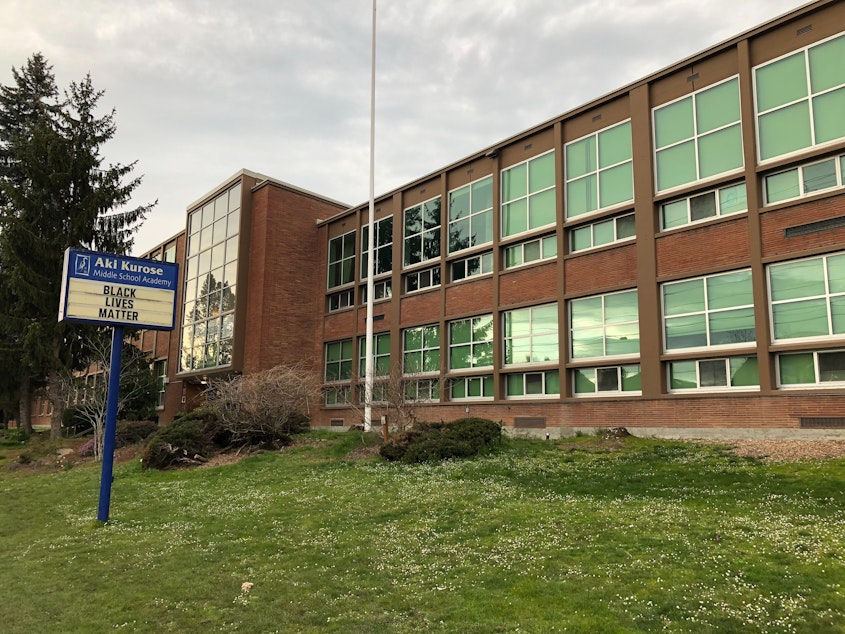

Seattle teachers, parents, and students remain on edge after unconfirmed reports swirled earlier this week that immigration enforcement officers were operating near several schools.
Meanwhile, district leaders say they’ll do more to support school staff when such reports emerge.
The accounts of Immigration and Customs Enforcement activity led four schools in south Seattle — Mercer International Middle School, Aki Kurose Middle School, Cleveland STEM High School, and Maple Elementary — to enact shelter-in-place protocols for several hours Tuesday, according to district officials. That means all of a school’s exterior doors are locked while normal instruction and operations continue inside.
Other schools nearby took different “precautionary measures,” the district said — including Dearborn Park International and Beacon Hill International elementary schools, which the district had earlier incorrectly said sheltered in place.
District officials previously called the reports of Immigration and Customs Enforcement activity “credible,” but in a statement Wednesday said security staff were at each school that sheltered in place Tuesday and “did not observe any ICE presence at or near SPS campuses.”
“The district continues to monitor information closely and works to verify all reports before acting,” the district said, adding that it “remains alert to community concerns.”
Sponsored
Sponsored
Interim Superintendent Fred Podesta said Wednesday the district has strong policies in place if immigration enforcement affects a school building, and that all principals have been trained on them.
He also emphasized that ICE agents are not allowed on district property without a verified warrant or court order.
But Podesta also acknowledged that the district can do more, including by better supporting principals who have to make decisions such as whether to shelter in place on the fly with little information — unlike when other law enforcement activity happens near a school.
“Usually there are hard facts and we’re working with law enforcement agencies. In this case, there’s just a lot of information flying around,” Podesta said. “I don’t think we’ve given school leaders all the tools they need for dealing with that ambiguity, so we are going to work hard to correct that to make sure there's a bit more centralized decision-making and consensus-building before we take action.”
A spokesperson for the Seattle Police Department said it received no calls reporting ICE near schools Tuesday. ICE did not respond to KUOW’s inquiry about whether agents had been in the area on Tuesday.
Sponsored
RELATED: The ICE surge is fueling fear and anxiety among Twin Cities children
Still, the incident has rattled local leaders and left Seattle school communities fearful — especially as immigration enforcement in Minnesota has led to children being physically hurt or detained, including a 5-year-old boy whose lawyers say he was used as “bait” to draw family members outside their home.
Washington Gov. Bob Ferguson on Tuesday wrote on X: “This is disturbing. We’re monitoring the situation closely.”
Seattle Mayor Katie Wilson’s team said it’s also watching the situation, but does not have “concrete information on increased ICE activity in Seattle.”
King County Councilmember Rhonda Lewis applauded the quick action taken by the schools, saying in a statement that she’s “concerned about the ongoing impacts of this kind of activity in King County, especially in historically marginalized communities.”
Sponsored

At a school board meeting Wednesday, half a dozen parents, teachers, and community members urged the district to take a stronger stance against immigration enforcement activity.
“There’s a lot of work being done by the community,” said one speaker, Gloria Ramirez, through an interpreter. “But we’re not getting that kind of support from the institutions — the school system, the district — that we need.”
Ramirez called on the district to provide families with more information, including through informational nights and workshops so they can better understand their rights and how to stay safe.
“The problems that we’re seeing right now — they’re big, and they're only going to get bigger down the road,” she added.
Sponsored
Parents and teachers also called for better communication from district officials if they receive reports of ICE near schools and decide to shelter in place.
Gela Simpson is a special educator at Aki Kurose Middle School. One of her kids attends Aki, the other Maple Elementary. Both schools sheltered in place on Tuesday. Simpson said she didn’t learn about the suspected ICE activity or shelter-in-place at Maple Elementary until a staff member texted her. Shortly after, one of her coworkers at Aki heard similar information, prompting their school to also shelter in place.
“There was a huge fracture with communication and the training that we have as educators in order to know how to respond appropriately,” Simpson said.
Simpson said most of her students didn’t attend school the following day — and those who did were frightened.
“At the end of the day, I don’t want to see my student running down the hallway screaming, ‘Miss Gela, I don’t want to be killed. I don’t want to lose my family,’” Simpson said through tears. “We have to do better.”
Sponsored
Jazmin Chavez, an educator at South Shore PK-8 in Seattle’s Rainier Beach neighborhood, said she’s seen an increase in families navigating ICE activity and deportation orders in recent weeks.
“Some students have already withdrawn, and others are at risk of leaving in the coming weeks or months,” Chavez told the board. “These are students who have built strong relationships and a sense of belonging at our school — and it’s heartbreaking to see that stability disrupted so suddenly.”
That fear has escalated quickly since Tuesday, Chavez said. Parents were scared to pick up their kids from school, and the situation “highlighted how vulnerable families are during moments of uncertainty, and how unprepared schools might be when fear spreads faster than accurate information.”
While the South Shore school community did its best to rally around families with support, Chavez said they need more support from district officials.
“Without clear structures, it has made coordination and collective action that much more difficult,” Chavez said.
“Our district serves a large population of families impacted by immigration policies — too many to ignore or treat as isolated cases,” she added. “Larger scale partnerships, clear guidance, or even a policy-level stance that advocates for our communities could help schools navigate these moments more thoughtfully and consistently.”
-
Sami West

Online Editor/Reporter
Sami West joined KUOW’s web team as an Online Editor/Reporter in 2025. Before that, she spent over two years covering education at KUOW, reporting extensively on mounting financial challenges in Seattle Public Schools and districts across Washington state. Her coverage also centered on growing concerns about violence in and around schools, teacher shortages, the youth mental health crisis, and the countless ways Covid continues to affect schools and families, among other topics.
More stories from Sami West »


