Can Washington state lawmakers cut their way out of a $2 billion shortfall?
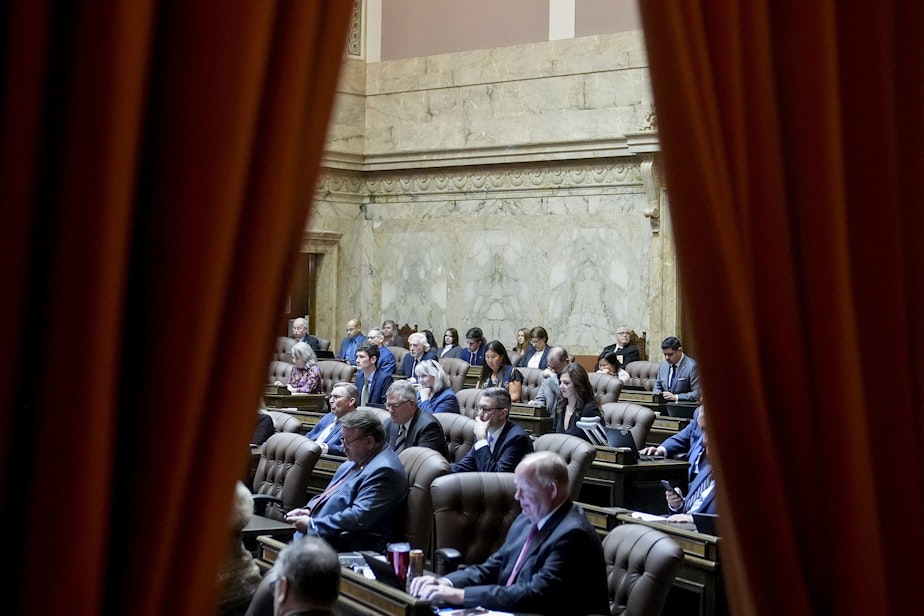

Washington state's 60-day legislative session started Monday in Olympia with lawmakers facing a $2 billion budget shortfall. Washington State Standard reporter Jerry Cornfield has been following lawmakers' attempts to soften the blow.
This interview has been edited for clarity.
Kim Malcolm: Jerry, this budget picture, it's pretty tough for lawmakers. They're looking at higher costs for some programs, even as they're facing more cuts beyond what they cut last year. And there's talk now about a so-called millionaires' tax and a possible state income tax. What kind of room do lawmakers have to maneuver here before they are supposed to reach a deal two months from now?
Jerry Cornfield: They don't have a lot of room to maneuver, but just to be clear, the income tax, even if it became law, won't produce any revenue to really solve their immediate problem. So, what they're going to have to do is play with what I call house money. It's their money. It's money that they might have put into other parts of fixing up the house, but in this case, they're going to shift it from, say, the Climate Commitment Act, which is hundreds of millions of dollars, and use that to balance things out. They're taking other big accounts and sweeping them, and getting rid of a couple tax breaks will be part of the discussion. That will seem like a tax increase to those companies, but it will eliminate some tax breaks that'll generate money, and then we’ll have to see what they do with the cuts to get it down to zero.
Where do you see the biggest fault lines appearing right now in the Democratic Party?
Within the Democratic Party, it will be some pressure to raise new revenues. I'm sure there'll be suggestions. They're still trying to fix the ones they passed last year, and that could affect the problem. But to the extent that they shift a lot of money from the climate account, or take more money from the rainy day reserve — the governor wants to take $1 billion. That's half of it. They might want to take more. And I dare say there's a few with their fingers crossed that the February forecast of revenue will be better than they predicted, and so if the economy takes even a small turn for the better, they'll all breathe easier.
The Republicans, of course, are in the minority. They've been criticizing the way things have been moving for some time, basically saying you're spending too much and you don't know how much money you're going to be having in the future. Do they have any role to play here in these discussions?
I think the biggest role may be on how much of that climate money gets shifted over into the general fund. They'll say it's for the Working Families Tax Credit. But regardless of where it goes, that'll be one issue, because they like that idea. They proposed it last year. They're going to propose cuts in various programs that probably won't save a lot of money, but they will get, you know, they might save a few million here and a few million there. While they don't have any big ideas for hundreds of millions of dollars in cuts, they do have ideas for not doing programs, not expanding programs, and in their mind, that saves the hundreds of millions of dollars that are in the shortfall.
I did want to ask you just briefly about an ethics issue that has come up for Governor Bob Ferguson. The state Executive Ethics Board ruled last week that Governor Ferguson likely violated state law by allowing his former advisor Mike Webb to travel with him on a state plane last summer. Has the governor told you anything about this ruling. How has he responded?
He has not responded directly since Friday. We did see him this morning to ask, and he said he had not looked at it yet, so he hasn't answered the charges directly. He does have 30 days under the rules to either seek a hearing so he can contest the claims and the allegations, or he could just enter into conversations with the board to try to settle the matter. If you go that route, you might see a penalty of a few hundred or a couple thousand [dollars]. Who knows, it could be suspended. So it could be a while before we have an outcome.
For folks who maybe don't pay super close attention to what the Legislature does from session to session, is there a particular issue that might take everybody by surprise this time around?
I don't know if there'll be anything that takes you by surprise, but I do think the conversation about what's happening in the federal government, the Immigration and Customs Enforcement actions, policing actions, I think those are going to garner a lot of discussion this week. There are bills about face coverings of ICE officers and banning those, and I think that could carry through the whole session, depending on what happens in the other Washington. And I don't want to forget about the storm damage, the floods. Those will come up at different times, hearings they need to deal with, to help folks recover.
Listen to the interview by clicking the play button above.
-
Kim Malcolm

Afternoon News Host
Kim is the local news host of KUOW's All Things Considered, airing from 3 p.m. to 6:30 p.m. weekdays. Kim covers breaking and developing daily news, both local and regional, as part of NPR's afternoon drive time programming.
More stories from Kim Malcolm »


