For Seattle kids with disabilities, welcoming day camps can be hard to find

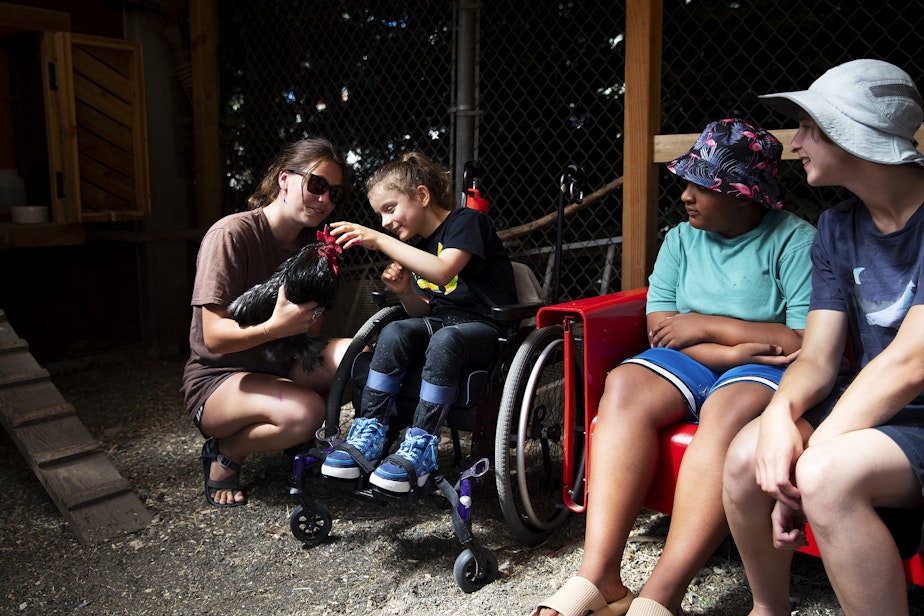

When school is out for summer, many Seattle-area families rely on day camps for critical child care, and a chance for kids to spend sunny days outdoors, making friends and learning new skills.
For parents of kids with disabilities, however, welcoming day camps can be hard to find.
Adjua Dupree’s daughter Gwen is 7 years old, has Down syndrome, and loves playgrounds, singing, and swimming. (I met Gwen and her mom when our kids were inseparable kindergarten friends.)
During the school year, Gwen spends much of the day learning and playing alongside typically developing kids. Come summer, however, Dupree says there aren’t many day camps that will take her daughter.
Gwen doesn’t run very quickly, so keeping up with other kids can be hard. And she’s petite, so if a bathroom isn’t accessible, she needs a boost.
Dupree reads camp websites carefully to see whether they’re open to taking kids with mobility challenges. If a camp looks promising, she still has to get on the phone with the camp director.
“Now some of the camps have been putting out the frequently asked questions that parents of kids with disabilities want to know, and it just weeds them out," Dupree said. "Like, ‘We can't accommodate this, this and this and this. We can’t accommodate you.'"
Sponsored
Or they can accommodate you — if a caregiver accompanies the child all day at camp. That's unfeasible for most families.

For neurodivergent kids, it can be difficult for parents to anticipate how their children will do at a new day camp.
Andrea, whose 8-year-old son has ADHD and sensory challenges, said some day camps go really well. (KUOW is using only her first name to protect the family’s privacy.) At other camps, she’s gotten what parents of kids with disabilities refer to as “The Call”: The counselors weren’t able to work with her son. His behavior was a problem. He wasn’t allowed back.
“There was one camp where he had art projects drying that we forgot to bring home because he was just sent home on Tuesday,” Andrea said. “They didn't even communicate to me what the problem specifically was, so I had no chance to talk to him about it and make a plan with the counselors and make a plan with him. It was just ‘Nope, you're done.’”
Sponsored
Another time, Andrea said, her son was excited about his dance day camp, and the end-of-the-week performance for parents.
“He loves performing," Andrea said. "He loves being on stage."
A few days in, the camp director told her he couldn’t finish the week.
“He cried all the way home,” Andrea said. “I'm kind of tearing up a little bit right now, just thinking about it. It’s heartbreaking, actually — that he can't have the same experiences as his peers. And that these adults, who are supposed to be experts in taking care of children, just have no way of seeing beyond just what their view of normal is.”
Some day camps have recently begun to offer weeks specifically for kids with disabilities, although they usually can only accommodate certain disabilities. Andrea said some camps offer only one inclusive week per summer.
Sponsored
“Sometimes that clashes with the other camp that has only one week out of the summer to offer those accommodations," she said.
Dupree says the City of Seattle does offer a good day camp for kids with disabilities, but for only four hours a day, four weeks each summer. That’s compared to the 7 a.m. to 6 p.m. camp the city offers typically developing kids — at 16 different sites — all summer long.
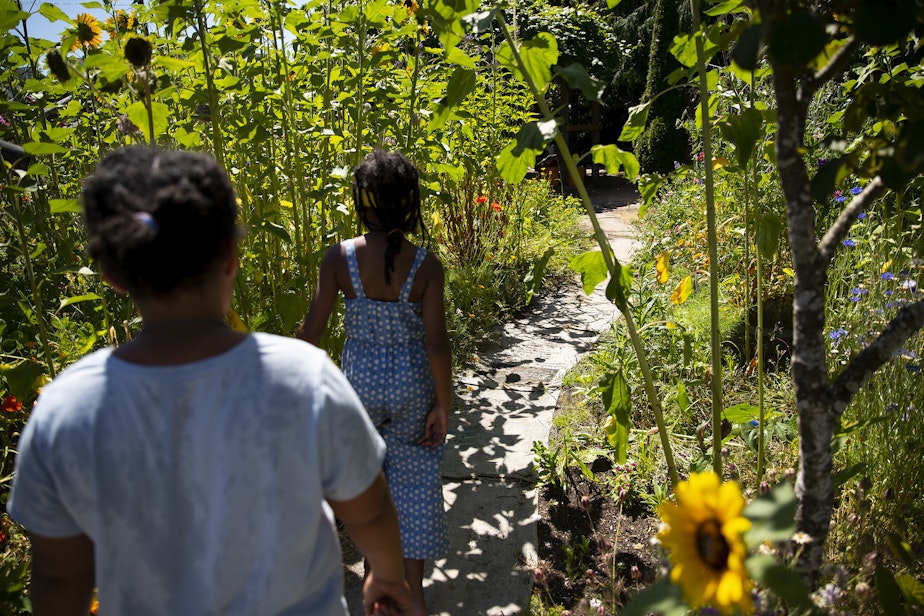
Dupree’s favorite day camp is Seattle Children’s PlayGarden, in Mt. Baker. It welcomes kids of all abilities, with accessible play equipment and facilities, and a garden full of sunflowers and berries.
For Dupree, it’s a huge relief to drop Gwen at a camp where she knows her daughter will be safe, included, and appreciated — where her disability is welcome.
Sponsored
“As soon as I drop her off, she’s lost in flowers," Dupree said. "The whole place is safe for her, and there's so many different activities that she can do."
PlayGarden offers day camp weeks for teens and young adults, too.
On a recent day, after the campers had a morning dance party on the basketball court to Katy Perry and Taylor Swift, then learned how to make soap, 16-year-old Ronnie Papp took a break to bask in the sun in a disc swing on the playground. She has a neurological condition that impairs her movement, and has been coming to programs here since she was a toddler.
At other day camps Papp has been to, she’s felt left out when she couldn’t take part in all the activities.
“Whenever I walk in these gates, it’s just so happy,” Papp said. “You’re always accepted. And even if you can't do one thing, the counselors and the staff, they always try to include you.”
Sponsored
Liz Bullard was a speech therapist before she founded the PlayGarden, which began its summer programs in 2006 and later added a preschool. One of the many benefits of enrolling kids of all abilities, Bullard said, is that typically developing kids can go to the same day camp as their siblings with disabilities. Bullard said she had assumed that by showing that inclusive day camps are feasible, others would replicate the model across the region.
“There could be many PlayGardens. We have huge waiting lists, so there’s a huge need,” Bullard said. “But for some reason, it's not really happening just by demonstrating that it could happen.”
Seattle’s Parks Department Specialized Programs day camp for kids with disabilities has a waiting list, too.

Bullard says PlayGarden has trained dozens of other programs on ways to work with kids with disabilities, and published a how-to manual that’s also available for free on the organization’s website. She says being fully inclusive can require more staffing — by far camps’ biggest operating expense.
But, Bullard said, including more kids with disabilities primarily takes open minds, flexibility, and motivation.
“We've had people say, ‘Well, we go down to the beach, and how do you get a child in a wheelchair down to the beach?’" Bullard said. "Our response is, ‘Well, you can take them out of their chair if parents show you how, and carry them to the beach.'"
Many accommodations are simple and free. Many neurodivergent kids, like Andrea’s son, depend on structure, routine, and predictability.
“So they could send out a schedule the Friday before camp starts so my son and I could talk over the weekend about what to expect,” Andrea said.
Communication between camp staff and parents before and during camp is also key, she said, so they can share details like what it looks like when a child gets overwhelmed and needs to take a short break to decompress.
Bullard said she's heard from many parents over the years that they avoid disclosing their children’s diagnoses when they sign up for mainstream camps for fear of being turned away.
When PlayGarden staff hold trainings with other programs, she said, they stress the importance of inviting parents to share their kids’ challenges, and strategies for how to work best with their campers.
“We really emphasize that the parents are so eager for their kids to be accepted there, and they're so eager to share with you how to help them be successful,” Bullard said.

PlayGarden, which is a public park when programs aren’t in session, gets its rent offset by the City of Seattle, and has received other public funding, including from King County’s Best Starts for Kids levy for training other programs.
In recent years, however, its local government funding has become sparse, Bullard said, and the organization relies on private donations to keep its day camp and other programs afloat.
At the Seattle Parks Department, spokesperson Rachel Schulkin declined an interview request, but said by email that the city is proud to offer four weeks of day camp for kids with disabilities and four weeks of overnight camp.
Schulkin said the city recognizes “the need for more specialized programming by the private and public sectors,” but offers “the level of service we believe we can safely and effectively provide given current funding and staffing levels.”
Adjua Dupree says she’d like to see much more public investment in making the day camps typically developing kids enjoy accessible to all kids. She has been glad to see some day camps working to include more kids with disabilities — although they still usually limit the accommodations they can provide.
“Parents of disabled kids, too, want their kids to have these very vibrant summer activities, want them to be in theater — to build robots, to be doing math, and playing in the woods, learning about nature,” Dupree said. “That’s not just parents of typically developing kids. We all want that, for all of our kids.”


