He suffered two strokes. This electric brain implant helped him regain use of his arm


Perhaps the most compelling finding from a UW Medicine study to help stroke victims recover hand movement is that if its first subject applied to be part of the study today, he would not qualify.
After just six weeks of intensive rehabilitation accompanied by electrical stimulation directly on the surface of his brain, 53-year-old stroke victim Matt Kidd regained more function in his hand and arm than he had during more than a year of physical therapy.
When Kidd, who suffered strokes in 2012 and 2021, was picked to be part of the study, “he was smack in the middle of our range in terms of functionality and daily living and what he could do,” said Dr. Jeffrey Herron, a researcher and assistant professor at UW’s Department of Neurological Surgery.
When the study began, Kidd could barely hold a broom handle out in front of him with both hands. After six weeks of rehabilitation, he could lift the handle over his head with eight-pound weights on either end.
His arm and hand movement are so much better now that he would not qualify to participate in the study.
Sponsored
“We blew him out of that range,” Herron said.
The extent and speed of Kidd’s improvement — especially in terms of his stroke-affected left arm — was remarkable, said Dr. Jeffrey Ojemann, a neurosurgeon who has been studying the human brain for more than 20 years.
What’s more is Kidd has maintained his new abilities even after his rehab has ended. The electrical device that was used to stimulate his brain is no longer on, but Kidd can still do things he couldn’t do before, which suggests a successful rewiring of his brain’s neural pathways.
“The long-term hope is to have a device that can be widely used, that it will [help patients] recover from any injury,” Dr. Ojemann said. “We hope someday to move from stroke to any situation where there's brain function that can be restored, redirected, and have improved function. So that could be from speech deficits, it could be from head injury, it could be from Alzheimer's — any neurologic condition.”
Sponsored

Last summer, Kidd, a marine mechanic from Covington, Washington, became the first human to have an electrical device developed by the German company CorTec implanted in his head.
One reason Kidd wanted to participate in the UW stroke study was that he knew the research could help others. Everyone he meets has either had a stroke or knows someone who has had a stroke, he said.
“It kind of takes all the wind out of your sails when you have a stroke,” Kidd explained. “I think everybody deserves a chance for a better story.”
After he recovered from brain surgery, he underwent intensive rehab while the CorTec device was activated.
Sponsored
Ojemann, Herron, and their team believe direct electrical stimulation targeted to specific parts of the brain during physical therapy can increase “neuroplasticity,” the brain’s ability to restructure itself after a debilitating injury or a stroke.

“The part of the brain we targeted really only controlled certain hand movements, and yet we saw recovery very dramatically in Kidd’s shoulder and his elbow, in different wrist movements and a lot of coordinated movements, too,” Ojemann said. “It's pretty simple for the brain to give the command to move something, but what we all spend a lot of brain power doing is coordinating the different parts of our hand and arm to make wonderfully complex movements. And those are the kind of things that he was able to recover.”
Almost 800,000 people experience a stroke every year in the U.S., according to the Centers for Disease Control and Prevention. Close to half either have moderate to severe impairments or require long-term care.
Kidd has survived two strokes. After his first in 2012, he had to relearn how to walk and talk. His second stroke hit on Memorial Day 2021 after he had spent the holiday at the Packwood Flea Market.
Sponsored
At a family barbeque that evening, Kidd told everyone he was going home because he didn’t feel quite right.
He drove himself to Harborview. He was admitted, given a shot, and spent the night at the hospital.
“When I woke up, I couldn’t move my left arm and my left leg,” he said.
Kidd was transferred immediately to rehab, where he remained for a month. But the focus of his physical therapy was mostly on getting him up and walking, his longtime partner Tessa Kidd said. (She took Kidd’s name, but the two are not married.)
“That was really their entire goal, that he can get himself up and down stairs,” she said. “They didn't really work on his arm at all, only his lower mobility, just hoping that he could get around.”
Sponsored
After that first month, even though Kidd continued with physical therapy, like many stroke victims, his recovery was limited.

More than 4 million Americans are living with the effects of a stroke. Only 10% of those people will recover fully.
Going into the study, Kidd was determined that he was going to push himself, but also that he and the UW researchers were going to enjoy the process.
“I want you to push me. I want to act like I'm going to bootcamp every day, and we're going to have a good time,” he said.
Kidd learned to throw a foam ball with his left hand as his therapist would try to catch in a bucket. His service dog, a dachshund named Bentley, chased after wild throws the therapist missed.
Every week, researchers made videos to show Kidd’s progress.
“It was the most shocking thing to see when you compare side-by-side, week one and week four,” Tessa Kidd said. “It took my breath away.”
While the doctors and researchers noted Kidd’s improvement doing complex movements during rehab, she noted unexpected changes in their lives at home.
One morning, she noticed that Kidd was using both hands to put toothpaste on his toothbrush, something he usually did using only his right hand. Another day, Kidd reached up and opened the shower curtain with his left arm. He also unconsciously started using his left hand to change TV channels with the remote control.
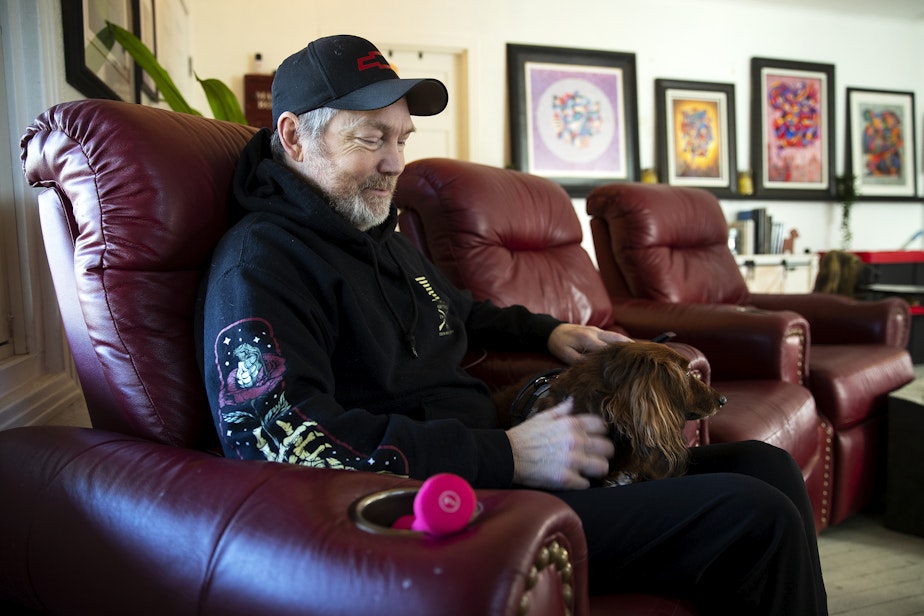
One night, they were getting ready for bed and Kidd picked up Bentley to carry him into the bedroom. He grabbed him with his right hand but then put the dog under his left arm.
“I know it sounds like it’s nothing, but it was such a huge deal to me when I saw it,” Tessa Kidd said. “That’s when I realized that it was really, really working.”
While the results are encouraging, Ojemann cautioned that Matt Kidd is the first and only patient in the study so far. Additional participants must be studied to see if they can replicate Kidd’s remarkable gains.
The research team is now recruiting the next three study participants.
“There’s a lot that we have to learn about who responds and who won’t,” Ojemann said. “These things are all going to require more study to be sure before we start proposing that something this invasive be mainstream.”
Kidd will continue to be monitored in the coming months. The device will be removed from his head during a second brain surgery next summer.
Tessa Kidd said the one thing she and Matt are looking forward to is getting back to their electric bikes, which they have ridden a total of 4,500 miles in the last few years. They had to forgo riding last summer because Kidd was taking part in the UW study.
When they ride their e-bikes, Tessa Kidd carries Bentley in a backpack. Since they bought e-bikes and started riding, the couple has traveled across the Pacific Northwest and seen bears, a moose, snakes, coyotes, and cougars.
Matt Kidd, who used to love riding Harleys and experiencing the open road, said getting out in nature on his bike has been “life-altering.”
“You really can’t tell I’m disabled on my bike,” he said. “I really thrive to be normal and get out in the woods. My only release in life anymore is to get on my power bike and ride it.”
-
Stephen Howie

Senior Online Editor/Reporter
Stephen Howie is a Senior Online Editor/Reporter at KUOW. He is an award-winning journalist, nonfiction writer, college professor and videographer. His first book, "The Bluffton Charge: One Preacher’s Struggle for Civil Rights" won the Mammoth Books Nonfiction Prize.
More stories from Stephen Howie »


