Justice Department 'workaround' keeps former immigration judge as Seattle’s top prosecutor
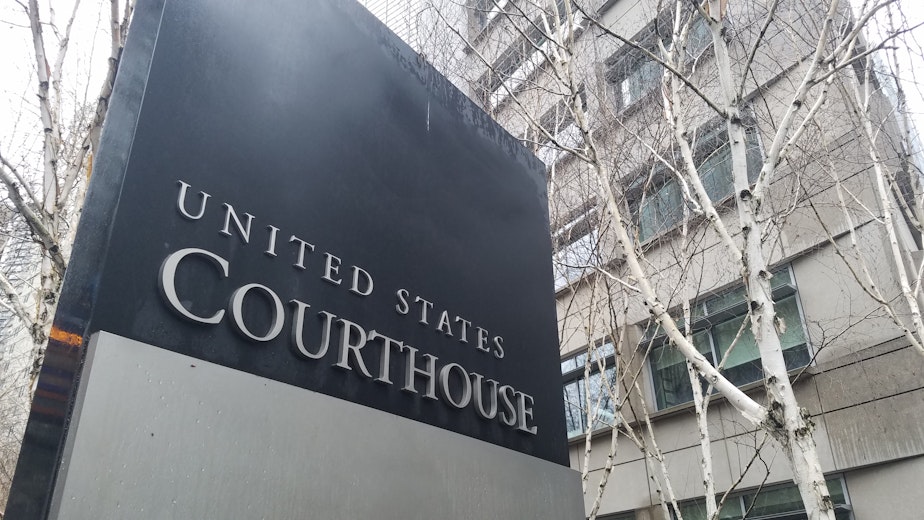

The Trump administration is using a workaround to retain its preferred U.S. attorney in Seattle, despite his lack of confirmation by the U.S. Senate. It’s a tactic the Justice Department has employed elsewhere, resulting in some legal challenges.
Former immigration judge Charles Neil Floyd has served as “interim” U.S. attorney for Western Washington since October. But facing a crucial deadline this week, the Justice Department changed his title to "First Assistant U.S. Attorney" — as it has done for Pete Serrano in Eastern Washington. The change keeps Floyd as the leader of the Seattle office, for now, since the position above him is technically vacant.
“While my title has changed, what has not changed is my leadership of the men and women of the U.S. Attorney’s Office," Floyd said in a statement to KUOW. "It is an honor to lead the experienced litigators and professional staff who work every day to do justice in our community.”
He added, “My background in immigration law has been very useful as we respond to department priorities around immigration enforcement.”
RELATED: Newly released court records reveal misconduct inquiry into federal judge
Floyd has previously served as an assistant U.S. attorney, a prosecutor with Immigration and Customs Enforcement, an immigration judge, and a judge advocate in the U.S. Army. As an immigration judge in Tacoma, he helped initiate a new policy for immigration courts to more routinely deny bond, keeping many people in detention who in the past would have been released pending the outcome of their cases.
Sponsored
Matt Adams is legal director for the Northwest Immigrant Rights Project, which brought a successful class action lawsuit to challenge the stricter bond policy. Adams said district courts across the country have found the policy unlawful but as interim U.S. attorney, Floyd has continued to defy those rulings and apply the new policy.
“How can the government that is responsible for enforcing the law at the same time willy-nilly be trampling over the law?” Adams asked.
In a Jan. 14 order, U.S. District Judge Tiffany Cartwright in Tacoma wrote that she was granting class members further relief "under a judgment they have already won" due to the government's "noncompliance."
The government has appealed her rulings, and the Ninth Circuit Court of Appeals will hear oral arguments in the case March 4.
U.S. Sen. Patty Murray, a Washington Democrat, said she would block Floyd’s confirmation because that policy for immigration courts “does not align with Washington state’s values.”
In a statement Wednesday, Murray said the move to retain Floyd as first assistant U.S. attorney “spits in the face of the law and Congress—and it sets a dangerous precedent and risks jeopardizing the legitimacy of the U.S. Attorney’s office moving forward.”
In an interview last month with conservative journalist Jason Rantz, Floyd said Murray had never contacted him. Floyd said he believes he’s qualified for the position of U.S. attorney, and said turnover in the job just creates uncertainty and hardship for the people working there.
Sponsored
Federal courts have the option to appoint a U.S. attorney in these situations, and last month Seattle’s chief district judge, David Estudillo, announced that the court will review applications and appoint a new U.S. attorney this spring. That person could function as Floyd’s superior if he remains with the office, or he could potentially apply as well.
RELATED: Federal judges are powerful. Some of their law clerks describe a toxic work culture
Liz Porter, a professor at the University of Washington School of Law, said U.S. attorney choices matter because they set the priorities for civil and criminal enforcement of federal law in the region.
“U.S. attorneys are important federal officials and under our constitutional system there’s supposed to be advice and consent by the Senate,” Porter said.
Meanwhile the Senate’s veto power is meant to “be a forcing mechanism for some sort of compromise” so that the president nominates someone “agreeable to both the president and the senators of a particular state,” she said.
Sponsored
Instead, Porter said Trump’s Justice Department is trying to keep its preferred appointments in place by workarounds like changing their job titles, rather than seeking candidates that can win confirmation. Porter said there’s sort of a common theme between the administration’s attempts to install its U.S. attorneys and its defense of novel immigration policies.
“The administration isn’t totally disregarding judicial pronouncements. It’s not totally disregarding the law of appointing U.S. attorneys," Porter said. "But in both situations, it’s invoking technicalities to circumvent the clear import of the law.”
These issues may seem obscure and technical, she said, but “these unglamorous moments are the rule of law.”
Porter said previous administrations have sought similar workarounds to avoid Senate confirmation.
“The Trump administration is not the first administration to do this. So maybe we’ll look at this as just one moment in time,” she said. “But maybe not, because we’re looking at more data points that indicate less respect for the typical constitutional process right now.”
Update 2/5/2026: A spokesperson for the U.S. Justice Department said in a statement to KUOW, “Not only does First Assistant U.S. Attorney Floyd have nearly two decades of legal experience serving as a JAG and Immigration Judge, but he also bravely served our nation overseas with the U.S. Army. He continues to have the full support of the U.S. Department of Justice as he works to uphold the rule of law and keep Washingtonians safe.”
Correction 2/5/26: This story has been changed to more accurately reflect statements from Northwest Immigrant Rights Project legal director Matt Adams.
Sponsored
-
Amy Radil

Reporter
Amy Radil is a reporter at KUOW covering politics, government and law enforcement, along with the occasional arts story.
More stories from Amy Radil »


