King County saw the most street immigration arrests across WA in 2025

Immigration arrests in King County increased more than 300% from January to December last year. That’s according to federal records obtained by researchers at the University of Washington’s Center for Human Rights.
Immigration and Customs Enforcement arrests on the street increased steadily across Washington state in 2025. King County saw the most total arrests of any county in the state, with more than 1,000 people taken in by ICE – that’s about 44% of arrests statewide.
Yakima County saw the second-highest number of arrests, with about 400 total.
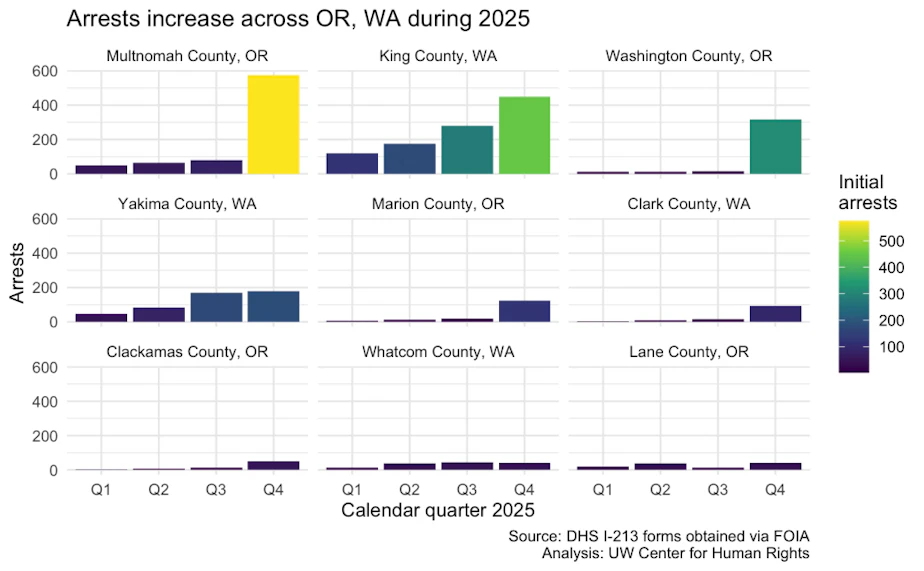
While arrests are not at the scale of places like Minnesota, Center for Human Rights Director Angelina Godoy said enforcement in Washington has stepped up.
“ I hear a lot of conversation here in Washington about, ‘We need to be ready. If they do like what they're doing in Minnesota, if they bring it here’… and in fact, I think this data shows they're already doing it here,” Godoy said.
Sponsored
There was a clear shift in who was being detained after President Donald Trump took office, Godoy said. By late 2025, she said people who had been in the country longer and who had more ties, including children born in the U.S., were being picked up.
RELATED: Seattle bans new ICE detention centers for 1 year
The number of arrests in Washington state are reaching the same record highs set by the Obama administration, according to researchers. The difference is in who is being detained: a large chunk of those Obama-era removals were immigrants with criminal convictions and people who were illegally trying to cross the border.
Godoy said immigration agents are using data from the Washington State Department of Licensing to check license plates and verify legal status. It’s part of a broader practice that’s being challenged in Oregon.
During last year's arrests, according to the researchers’ report, federal immigration enforcement agents worked in teams, “traveling to specific locations and running the license plates of vehicles they encountered to determine the name of their registered owners, and subsequently checking those names against their own databases to determine that person’s ‘deportability.’”
Sponsored
“This process enabled them to make an arrest within as little as ten minutes, including of many individuals for whom they had not previously obtained a warrant and about whom they made no individualized probable cause assessment of escape risk,” according to the report.
Many of these operations were at business parking lots like hardware stores and Latino shops, Godoy said.
“ I would still say that's basically dragnet enforcement, and it smacks of racial profiling extremely heavily,” she said.
RELATED: As reports of ICE emerge in Seattle suburbs, neighborhood watches take shape
Roxana Pardo Garcia has been a longtime resident and immigrant rights advocate born and raised in South King County. She comes from a community of mixed immigration status families, some without legal status, living in the U.S. for decades who are feeling the churn of mass deportation.
Sponsored
“People are trying to figure out how to contact family members of cars that have been left behind, because they are doing enforcement in public right-of-ways, they're doing it in traffic, and so they're kind of just leaving cars to the side,” she said.
Garcia also leads Alimentando el Pueblo, a group that started during the pandemic to provide food to people when more and more people were staying home – she said much of that pandemic way of life is returning to the community she serves.
“ There are apartment complexes that are being surveilled by these agents,” she said. “So, they're not wanting to leave their homes, and when they don't leave their homes, they can't work.”
Rosario Lopez sees a lot of the parallels to the pandemic as well. Lopez first began working as an interpreter for the rise of new immigrants seeking asylum in Washington in 2023.
Under the Trump administration, asylum-seekers increasingly have faced aggressive legal tactics to rush them through the immigration process. Trump had long promised these immigrants would be part of his mass deportation efforts, blaming President Joe Biden’s “open-borders” policy.
Sponsored
RELATED: Immigration detention on track for deadliest fiscal year since 2004
Of at least 300 families Lopez and their colleagues have worked with, only two have been able to secure pro-bono immigration attorneys. Others have had to pay for their own attorney, or don't have one. Lopez said the need for legal help will always outpace the number of attorneys available or willing to take up immigration cases.
There’s a laundry list of other items and critiques Lopez has shared with King County officials, but at the top of their list is getting King County leadership to sign onto a memorandum urging the governor's office to repeal federal immigration enforcement officers from using Department of Licensing data.
Lopez has personally seen how people who recently arrived as asylum-seekers, with immigration court hearings scheduled years into the future, are detained by immigration and later deported.
“Washington state is supposed to respect migrants’ privacy, but time and again, we see that they’re not really willing to put that into practice. It’s more like they’re just going through the motions, saying they won’t do something, but then failing to follow through,” Lopez said in Spanish.
Sponsored
Brionna Aho, a spokesperson for Gov. Bob Ferguson, said Washington state is working on options to limit federal immigration enforcement access to license plate data. “We have taken numerous steps to limit federal access of DOL data. We shut off ICE’s access to many systems, including our driver license and vehicle data,” Aho said.
Sponsored
But they’re caught between their need to limit Customs and Border Patrol access, Aho said, while keeping the “access necessary to protect public safety, such as human trafficking investigations that require real-time access to data to protect vulnerable Washingtonians.”
RELATED: In Seattle, 9th Circuit judges consider Trump policy of mandatory immigrant detentions
Correction notice, Friday, 3/13/2026 at 3:07 p.m.: A previous version of this story incorrectly stated how many of the 300 families Rosario Lopez and her colleagues have worked with who were able to get legal assistance.
-
Gustavo Sagrero Álvarez

Race, Identity, and Immigration Reporter
Gustavo covers the intersection of race and identity for KUOW, writing stories that center voices often not catered to in typical news. He's most interested in covering how communities effect the levers of power they hold, to effect change.
More stories from Gustavo Sagrero Álvarez »


