Seattle’s Fred Hutch marks 50 years of groundbreaking cancer research
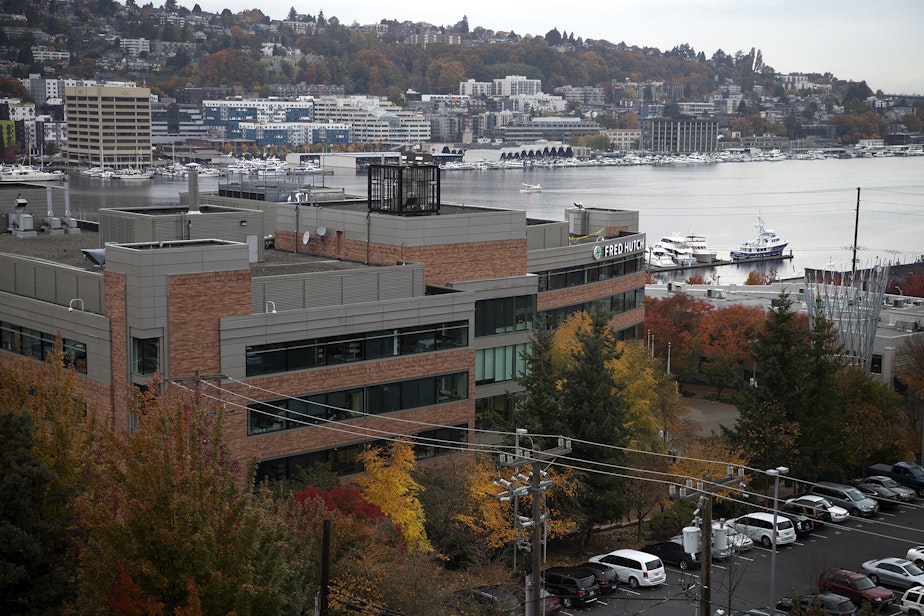

The Fred Hutchinson Cancer Center is celebrating a big birthday Friday. The center opened its doors 50 years ago, on Sept. 5, 1975. Since then it has evolved from a scrappy lab doing what some considered risky science into one of the top cancer centers in the world.
Some of the earliest work at what would become Fred Hutch took place underground in West Seattle, down three flights of fluorescent-lit stairs, to an old World War II era naval communications bunker.
“There was a treatment room and there was a separate room with total body irradiation sources. The rest of it was abandoned radio equipment,” said Dr. Rainer Storb, a member of that first tiny team.
They were testing radiation treatment on dogs, as part of a big scientific bet. The research team, led by oncologist E. Donnall Thomas, was looking to treat leukemia, not with chemotherapy or surgery, but with a bone marrow transplant.
Leukemia was usually fatal, and the early transplants were no less deadly.
“The early attempts were grim. They all failed. There were something like 200 published cases. All of them died," Storb said.
Sponsored
Ambitious research
Meanwhile across town, a doctor named Bill Hutchinson was dealing with a personal loss. His brother Fred, a professional baseball player and manager, had just died of lung cancer.
Bill was already leading a research group, and he decided to create the cancer center in his brother’s honor. He folded in Storb’s team and launched what amounted to a startup.

“I can’t believe it’s been 50 years,” said Harold Varmus, former director of the National Institutes of Health and the National Cancer Institute and currently professor of medicine at Weill Cornell Medical College in New York. “I remember very distinctly when it was started. Some of the most original scientists in the country were signing up.”
Sponsored
RELATED: Why lung cancer is a 'hidden epidemic' in this part of the world
Varmus watched Fred Hutch from afar from the beginning. He says all along, the growing cancer center was known for taking big swings.
“I always felt that it was one of the more original, forward-looking, modern cancer centers, not simply doing a lot of clinical trials, but trying to understand the essence of cancer. [It was] a place that was looking at the future with open eyes and trying to make discoveries,” Varmus said.
Hard-won breakthroughs
Curing leukemia with a bone marrow transplant required multiple breakthroughs over a period of decades. Researchers had to solve problems with the disease recurring, with matching the donor to the recipient, with the graft attacking its new host, and with the constant threat of infection in immunocompromised patients.
Sponsored
The scientists tackled the challenges methodically, finding success first in transplanting between identical twins, then non-twin siblings, and finally between unrelated people.
In 1991, Dr. E. Donnall Thomas received the Nobel Prize for finally cracking the bone marrow transplant puzzle.
“It takes a long time to accomplish these objectives,” Thomas said in his Nobel lecture. “We mustn't be too impatient, but clearly great progress has been made.”

The prize put Fred Hutch on the map worldwide. It also got the attention of a young Thomas Lynch Jr., who’s now the Center’s president and director.
Sponsored
“I learned about Fred Hutch when I was a kid,” Lynch said. “My father was a hematologist and he told me, ‘The Fred Hutch in Seattle, they're doing something called bone marrow transplants.’ I’d never heard of bone marrow transplants. I was 12 years old! And he said, ‘It’s high-risk, but they’re able to cure children and young adults with leukemia,’ which was just unbelievable.”
That groundbreaking work set the stage for other advances, including transplantation technology, immunotherapy, and precision medicine. Beyond cancer, Fred Hutch has become a major player in HIV research and public health.
RELATED: NIH scientists call on director to protect biomedical research
Lynch said the Hutch’s success is partly due to its DNA as essentially a startup that has always been willing to take risks.
“Seattle is a center of innovation. And if you look at the growth of Microsoft and Amazon and Starbucks and Costco, it’s not crazy to think that that same cauldron of innovation would have launched the Fred Hutch,” he said.
Sponsored

Growth and challenges
Since 1975, Fred Hutch has gone from 286 employees to 6,100, and racked up three Nobel Prizes. Its campus on Lake Union includes 2.5 million square feet of space.

That growth hasn’t come cheap: The Fred Hutch Cancer Center’s annual budget tops $2 billion.
And now it’s facing a harsh financial outlook. Federal cuts to science and health funding, including at the National Cancer Institute, have hit Fred Hutch hard.
RELATED: Supreme Court allows NIH to stop making nearly $800M in research grants for now
This spring, the cancer center announced layoffs of IT workers as well as “research-related staff reductions,” though they didn’t say how many people would be cut.
Lynch said, in the long run, he believes Fred Hutch will be able to weather the storm.
“I think the Hutch is well positioned because our science is supported both by the government and by foundations, and by the people of Seattle. People in Seattle have been extremely generous to Fred Hutch. And that philanthropy goes directly to supporting research and patient care,” he said. “Because of that diversity, I think that’s helped us weather some of these storms.”
Fred Hutch marked its 50th birthday with a festival this summer, as well as a big fundraising campaign.
-
Gabriel Spitzer

Editor
Gabriel Spitzer is an editor working with the newsroom and the Sound Politics team. He has worked in just about every editorial role in newsrooms from NPR to WBEZ to Alaska Public Radio Network.
More stories from Gabriel Spitzer »


