Washington state voters have rejected income taxes 10 times. Is this year different?


Hundreds of demonstrators swarmed the steps of Washington’s state Capitol Monday, waving signs saying, “Tax the rich — they can afford it,” and, “Blue collar over billionaires.”
“We have to fix our tax code, and we have to do it now!” called state Rep. Emily Alvarado, a Democrat from Seattle, to cheers from the crowd.
Washington is the only solidly Democratic state with no income tax, and this crowd and the Democratic lawmakers in attendance want to change that.
The best shot they have — a tax on households making more than $1 million a year. Gov. Bob Ferguson and top Democratic leadership in Olympia have thrown their support behind a proposal, which hasn't been officially released yet.
Washingtonians have rejected income taxes 10 times in the last 90 years. Democrats and Republicans have tried and failed. So why is the vibe among tax reform advocates so optimistic?
Sponsored

'The devil we know'
The last time Washingtonians said "yes" to income taxes was 1932. Franklin Delano Roosevelt swept the nation and even flipped Washington, which hadn’t gone for a Democrat since 1900.
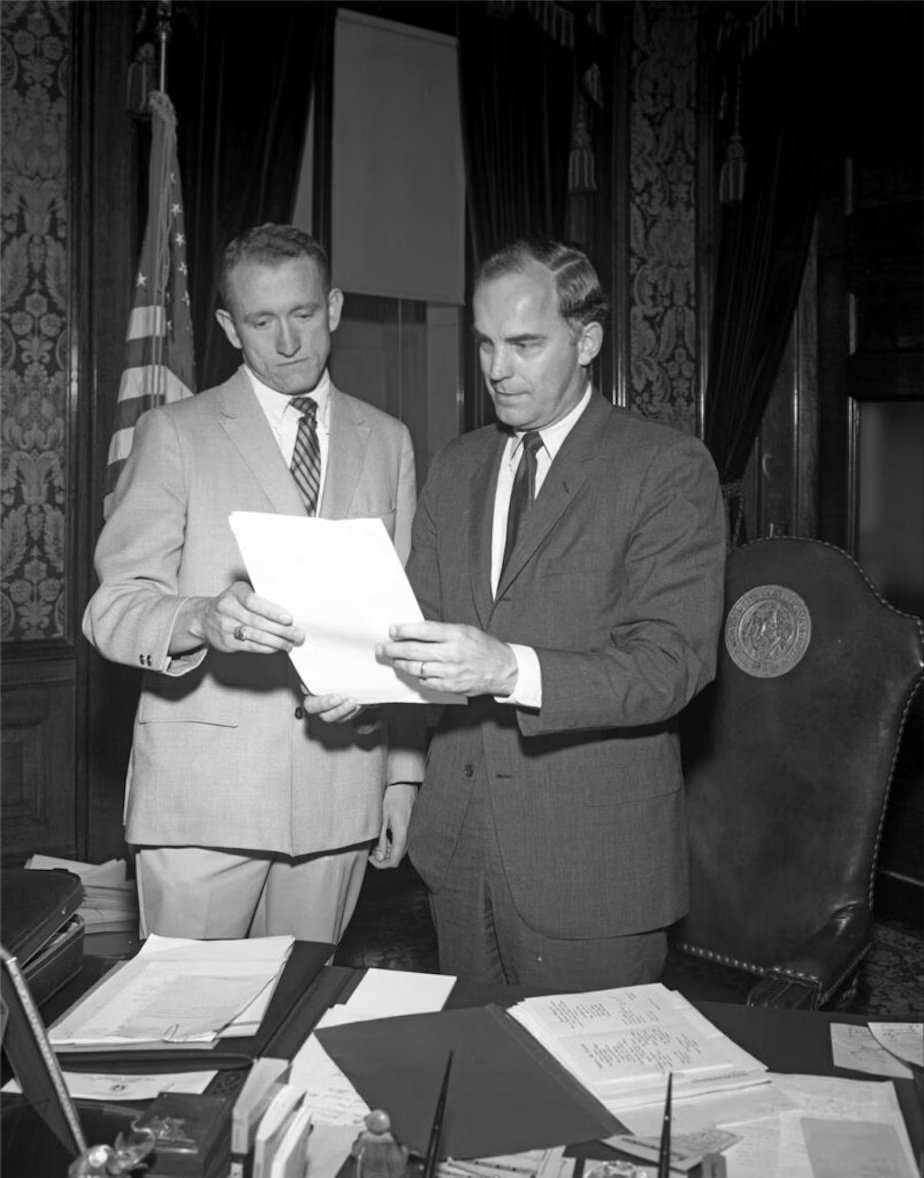
But the income tax won with an even higher margin, because it also capped property taxes — a cap that still exists today.
Sponsored
“The farmers felt that they were getting hammered by paying high property taxes when they didn't have the income,” legal scholar Hugh Spitzer said. “That’s why they got together with urban groups like the unions and the teachers to demand an income tax.”
But the income tax got knocked down the following year by the state Supreme Court. Justices said that under the state constitution — which specifies that property must be taxed “uniformly” — income is also property. So a graduated, progressive income tax that isn’t “uniform” on everyone, but taxes rich people more? Unconstitutional.
State leadership tried to pass a constitutional amendment to change that, and in the meantime, they enacted emergency business and sales taxes. But when voters took to the polls in 1934 to weigh in on it, they said "no" — perhaps because they were already feeling overtaxed, Spitzer said.
RELATED: The strange, short story of Washington state's income tax
State leaders tried again and again — in 1936, 1938, 1942 and 1944. Decades went by. In the '70s, Republican Gov. Dan Evans tried again twice.
Sponsored
“Is the tax system fair?” Evans said at a speech in Seattle after completing a "tax tour" of the state in 1973. “Is the price we pay, each of us, for the civilization we enjoy, equitable? I think the answer quite clearly is that it is not.”
Corporate tax efforts in 1975 and 1982 also failed.
“Washingtonians are used to a system without an income tax. It's the devil they know,” Spitzer said.
Who pays?
The last time voters said 'no' to an income tax was 2010.
Sponsored
The decade and a half since have seen a major shift in state and national politics when it comes to the wealthy. Even Gov. Bob Ferguson, a Democrat with a reputation for putting the brakes on new tax proposals, gave a "millionaire’s tax" his support last month.
“Look, I've been in politics now for over 20 years,” Ferguson told KUOW last week. “I spent a lot of time traveling the state and talking to people, and there is a growing sense, and that's probably an understatement, that there are greater inequities between the wealthiest and the vast majority of Washingtonians who are working hard to get by.”

In 2024, that shift surfaced at the ballot in an explicit way. Voters kept a capital gains tax that a small group of wealthy Washingtonians pay on sales of things like stocks.
Suddenly, it seemed like Washingtonians might be open to an income tax — if they think most of them won’t pay it. Polls show support for an income tax drops precipitously if that income goes down much below a million a year.
Sponsored
If you look to history for an indicator, the chances the income tax will remain limited to high earners are slim to none, said Jared Walczak, a senior fellow at the business-friendly nonprofit the Tax Foundation.
“When states first started adopting income taxes, many of them only applied to high earners,” Walczak said. “They went from something that targeted a small portion of the population to something that brought in just about everyone. ... It's hard to believe that eventually everyone won't be paying income tax.”
Gov. Ferguson’s response to that is emphatic:
“It's not going to be less than a million dollars. That's not what you're going to see. That's not what I'm going to sign,” Ferguson said. “Heck, I'd be supportive of a constitutional amendment to lock that in.”
'Yes to taxes' or 'Don’t repeal'?
Many of the ballot measure failures since 1932 asked voters to approve an amendment to the state constitution to get around that 1933 decision where the state Supreme Court said income is property.

Today, Democrats might not have to get around it. Spitzer, the state constitution expert, said if the question came up again before today’s state Supreme Court, he thinks they would rule differently.
“That thinking [in 1933] was way out of whack,” Spitzer said. “Our state is in a very small minority position from a legal standpoint.”
State House Republican leader Drew Stokesbary, also a lawyer, disagreed.
“Two years ago, the U.S. Supreme Court overturned Roe v Wade, and Democrats howled that it was a reversal of precedent,” Stokesbary said. “Those same Democrats suddenly want our state Supreme Court to… just overturn this old precedent.”
Confident the courts will back them, Democrats could pass a tax and then wait for a conservative like Brian Heywood to challenge it like he did the capital gains tax in 2024. Getting voters to say "don't repeal" an income tax that already exists might be easier than getting them to change the constitution to enact a new one.
That's not to say voters will just give a thumbs up to an income tax after 90 years of thumbs down. Democrats already raised taxes historically high last year.
Rachel Smith leads Washington Roundtable, a nonprofit representing corporate executives in the state. She said it’s hard for business leaders to plan during a shaky economic outlook when they’re not sure what taxes to expect.
“If you believe the adage, which I certainly do, that the number one enemy of business is uncertainty, having all of this change happen in a very short period of time is concerning,” Smith said.
Smith did not say if she was for or against an income tax, because the details of the proposal — what the tax would fund, for instance — aren’t out yet. That’s expected next week.
It’s one reason demonstrators were out on the Capitol steps this week. Their chants were mostly about funding housing and child care. When a chant of “tax the rich” broke out from some people in red teacher’s union scarves, it died pretty quickly.
Smith has pushed Democrats to drop the "villain" rhetoric.
"It's not helpful," Smith said. "I don't think that taxes, which are the resources that people pay to government to provide important services, should be framed as punitive."
-
Scott Greenstone

Politics Reporter, Host of Sound Politics
Scott Greenstone covers PNW politics for KUOW, from Congress to county officials, and how decisions in the other Washington affect life here. He co-hosts Sound Politics with Libby Denkmann.
More stories from Scott Greenstone »


