Eilís O'Neill
Reporter
About
Eilís is a reporter covering health. She focuses on health inequities, substance use and addiction, infectious diseases, mental health, and reproductive and maternal health.
Eilís came to KUOW in 2016. Before that, she worked as a freelance reporter, first in South America, and then in New York City. Her work has aired on NPR’s Morning Edition and All Things Considered, APM’s Marketplace, Reveal from the Center for Investigative Reporting, and other programs.
Eilís' work as part of a team covering Covid-19 outbreaks and vaccine hesitation in Washington won a regional Murrow award, as did a series about children who lost parents to Covid-19. Her series about the opioid crisis on the Olympic Peninsula won several regional Society for Professional Journalists awards as well as a national Public Media Journalists Association award.
Eilís grew up in Seattle and was a high school intern at KUOW, in the program that later became RadioActive. She has a Master's in Science, Health, and Environment Reporting from Columbia University. She lives in Seattle with her husband and two children.
Location: Seattle
Languages: English, Spanish
Pronouns: she/her
Stories
-

Western Washington was a sanctuary for trans youth seeking care — until RFK threatened gender clinics
Until recently, it seemed like gender-affirming care for trans kids would continue in liberal places like Western Washington, despite the Trump administration's crackdown. But families and advocates say access to that care is now dwindling in the Puget Sound region.
-

ICE agents often ignore safety and privacy practices for detainee patients, Tacoma nurses say
Nurses at a Tacoma hospital allege that ICE agents have repeatedly ignored practices safeguarding detainee patients’ privacy, health, and safety.
-

Reporter’s notebook: Looking into child welfare policies in Washington state
Washington state made two major changes to child welfare policy in the last several years to keep more babies and children with their families of origin. Almost a year ago, KUOW’s Eilís O’Neill set out to understand the effects of those changes.
-

Ovarian cancer is a 'silent killer.' Seattle doctors have a new prevention strategy
Women with certain genetic mutations are at extremely high risk of ovarian cancer. Now, some researchers are trying a new approach to preventing this deadly cancer.
-

Washington made it harder for CPS to separate families. Critics say kids are less safe
In recent years, Washington state has made two major policy changes to keep more birth families together. Since then, fewer kids have been taken from their birth families. But over the same time period, more babies and children from families who’ve been investigated by child welfare workers have died.
-
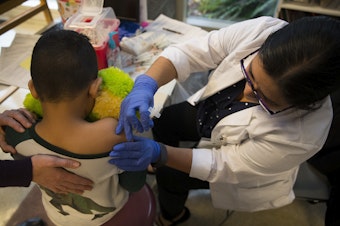
WA keeps recommending 15 vaccines for kids, dismissing new federal guidance
Washington state is continuing to recommend 15 vaccines for children and adolescents, in line with the schedule recommended by the American Academy of Pediatrics.
-

Katie Wilson is officially Seattle's mayor. Her agenda: affordability, housing, and workers' rights
Katie Wilson was sworn in as Seattle’s new mayor in a public ceremony at Seattle’s City Hall on Friday.
-

Pregnancy-related deaths are increasing in Washington state. Most could be prevented
Maternal deaths in Washington state rose in 2021 and 2022 compared to previous years, according to a report released by the state health department Monday.
-
Washington, other West Coast states, go against CDC, recommend hepatitis B vaccine for all newborns
A CDC panel voted on Friday to recommend the hepatitis B vaccine only to the babies of mothers who test positive for the virus, or whose status is unknown, and to suggest that, for all other babies, doctors and parents should have a conversation about the risks and benefits of the shot, a process known as “shared clinical decision-making.”
-

These Seattle-area clinics plan to take care of people who’ve lost their health insurance
Community health centers in the Seattle area are bracing for an influx of patients who can’t pay for their care.
