‘Jeopardy!’ host and WA native Ken Jennings ponders questions big and small
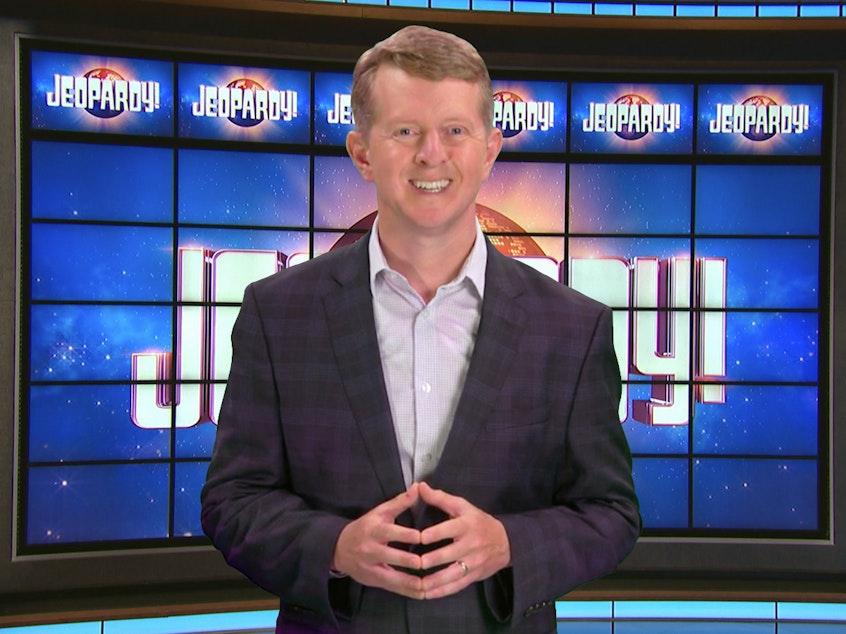

Ken Jennings hosts the game show "Jeopardy!" where he first came to fame as the highest-earning American game-show contestant. He is also a Washingtonian and the author of eight books, including his latest, "The Complete Kennections: 5,000 Questions in 1,000 Puzzles."
The book is a compilation of trivia questions in a game that started in Parade Magazine, a Sunday newspaper supplement. Magazine editors reached out to Jennings 15 years ago asking him to write a trivia column with the title, "Kennections."
“I was not in love with that name," Jennings said. "But the more I thought about it, I realized that they couldn’t fire me if my name was on the puzzle. Unless they gave it to Ken Burns.”
He took the column on, suggesting a simple trivia quiz where players would have to answer five questions, and then figure out what the five answers had in common.
An example is:
Sponsored
- What 2013 song made Lorde the first New Zealand artist to top the Billboard charts?
- What animals are Asia’s largest carnivores?
- Warren Beatty was nominated for three Oscars for what epic about the Russian revolution?
- In 2013, 115 electors from a “college” of what Catholic church chose Francis as the newest pope?
- What is the symbol for the astrological sign of Gemini?
Answers:
- Royals
- Tigers
- Reds
- Cardinals
- Twins
Kennection: The answers are all Midwestern baseball team names.
The game combines trivia knowledge and lateral thinking. Jennings said he was drawn to this type of game because of the two components.
Sponsored
“Factual recall of trivia is vital, but it’s not real,” he said. “The real problem-solving we have to do — the big leaps forward in creativity or even in science — are often a little more outside the box. You're not just recalling past information. You're trying to apply it or connect it or in a new way.”
Jennings believes that trivia changes the way people interact with the world.
“Many people, when they hear a fact they don't know, it unnerves them. You don't want to look dumb," he said.
But Jennings has the opposite reaction.
“I’m a treasure hunter. Tell me more. What does that mean?" He said. "If I'm online, I'll go down rabbit holes. I'll pause a podcast to look up something that happened 200 years ago. I think it's just people who are omnivorous about knowledge like that. I think they find the world a more delightful place to live.”
Sponsored
Jennings said he encountered a lot of those curious, self-made people on "Jeopardy!"
“They realized that the world was more interesting if you were curious about it,” he said.
He also believes memory works better when people specialize in something they love.
“You never have a hard time remembering the words of a song you like,” he explained.
As host of "Jeopardy!" Jennings said the pressure to know all the answers is greatly reduced.
Sponsored
“I like that 'Jeopardy!' gives me the correct responses,” he said.
When it comes to contributing to the questions, Jennings keeps a look out for something interesting and tries to think of how he could use it for a Kennection or whether he could pass it on to the "Jeopardy!" writers.
“We have an Emmy-winning staff who is amazing. You would not believe how much material 'Jeopardy!' eats. There's maybe 100 questions a day that the staff has to kick out, and they don't need me," Jennings said. "But if Alex [Trebeck, the former host] had an idea, occasionally he would pass it along. So, I do the same thing.”
RELATED: The late 'Jeopardy!' host Alex Trebek will be honored with a U.S. postage stamp
Jennings said he keeps a list of ideas in the Notes app on his phone, “and occasionally they'll humor me and put one on the show.”
Sponsored
One thing he’s learned since hosting the show is that it is very hard to judge which contestants will be able to perform well in front of the lights, cameras, and audience in a high-pressure situation.
“People who were great on a written test get overwhelmed in that [environment] because it is overwhelming," he said. "'Jeopardy!' moves so fast.”
Jennings said he understands the contestants are fulfilling a lifelong dream and there can be a lot of big feelings involved in a moment where many elements are out of their control.
With that in mind, he said he does things a little differently than his predecessor.
Alex Trebek would meet the contestants for the first time at the beginning of the show. Jennings prefers to introduce himself beforehand.
“I want to say, ‘I’m on your side here. We're going to do great. It's actually going to be fun when you look back on this, believe it or not,’” he explained.
Though modest about his memory and ability to be a competitive "Jeopardy!" player these days, Jennings still makes appearances on game shows when opportunities arise.
RELATED: As legendary 'Wheel of Fortune' host Pat Sajak retires, where do game shows go next?
Jennings recently made the news after winning the celebrity version of "Who Wants to Be a Millionaire?" He was partnered with actor Matt Damon and the pair won $1 million for water.org, a global nonprofit that provides safe water and sanitation in developing countries.
The pairing idea came from host Jimmy Kimmel, and while Jennings suspects Kimmel thought he’d be a good ringer who’d find it easy, he felt the pressure.
“The questions were difficult,” he said.
When comparing the two trivia shows, he said "Who Wants to Be a Millionaire?" is hard because, “if you don't know the answer to every single question, they send you home.”
"Whereas on 'Jeopardy!' if you don’t know 10 questions in a row, you might be fine,” Jennings said.
His strategy for "Who Wants to Be a Millionaire?" was to think of the answer before seeing the multiple-choice options the show offered him. The final question was, “Which of these words is used to describe one of the most beautiful auditory effects on Earth: the sound made by the leaves of trees when wind blows through them?”
He recalled the word “susurrus” which was presented as one of the options and then confirmed as the correct answer.
Jennings also had to contend with the three-decade long late-night "feud" between Matt Damon and Jimmy Kimmel.
“I knew that the joke was that Jimmy Kimmel would be annoyed that Matt was there, but I didn’t know that it was going to be 40 minutes of the Comedy Central roast of Matt Damon while we’re trying to win a million dollars,” he said. “At one point, Jimmy referred to Matt Damon as a yak because he had grown a big beard to play Odysseus, which he was filming across the lot.”
Kimmel did begrudgingly help the pair when they used the 'Ask The Host' lifeline, for a question about another Seattle native, Bill Nye.
“Growing up here, I watched plenty of Bill Nye on 'Almost Live!' but I had no idea that he’d won a Steve Martin look-alike contest,” Jennings shared. “But Jimmy had been a radio personality at the exact right time to know that story and he saved our bacon. He loves water.org more than he hates Matt Damon.”
When it comes to the role trivia plays in society, Jennings wants to puncture the myth that trivia exists to make somebody feel better about themselves or better than somebody else.
“Trivia should bring people together, because despite the name, it's not usually trivial. It's usually stuff that we collectively know as a culture,” he said. “Before the age of specialization, this was the kind of thing that united us as a culture. I like to think it has the potential to do it again.”
“Jeopardy in particular, is a place where, every night, for half an hour, facts matter,” he added.
Facts and fact checking matter more to Jennings with the rise of artificial intelligence.
Fourteen years ago, he participated in the "Jeopardy!" IBM Watson challenge, in which he and a fellow "Jeopardy!" contestant competed against a computer. The computer won over the course of three rounds.
“At that moment, I remember thinking, ‘This is really demoralizing.' Knowing stuff was the one thing that I thought made us special and human," he said. "It turns out IBM just hadn't thrown enough money at that problem yet.”
At the time, Jennings feared people would forgo knowing facts, instead opting to ask their device. He’s seen that come to fruition with the rise of smartphones and more recently ChatGPT.
What he did not predict was that AI prompts would "hallucinate" answers and provide incorrect and imaginary information.
“So now we have this thing that I'm already worried about its effect on our society, and it's not actually good at everything we assume it's good at," he said. "And the wrong answers could be life and death.”
"Jeopardy!" is recorded in Los Angeles, but Jennings considers himself a Puget Sound “lifer” and still lives in the region where he enjoys what he calls his “pleasantly limited fame.”
A practicing member of the Church of Jesus Christ of Latter Day Saints, formerly known as the Mormon church, Jennings has talked publicly about giving some of his game-show winnings to the church as part of his tithing.
He thinks that many stereotypes of religious people, from thinking them not particularly bright to being of a certain political ideology paints too broad a brush.
“I'm very lucky that I attend a lovely, fairly progressive, diverse, open-minded congregation here with great people. I just feel like a religious background has made me a better person, it reminds me of what kind of person to be,” he reflected. “And I do think that's something that the public sphere has started to lose. Not all churches are a cure for that. But in my case, it's been a really great fit, a blessing in my life.”
-
Libby Denkmann

Host, Soundside
Libby Denkmann joined KUOW in December 2021 as the host of the midday show Soundside. She’s a native Pacific Northwesterner who grew up in Redmond, graduated from the University of Washington, and covered local news as a producer and reporter with KIRO Radio.
More stories from Libby Denkmann » -
Sarah Leibovitz

Supervising Producer, Soundside
Sarah joined KUOW in 2019 as senior producer on The Record. She is now Supervising KUOW’s new noon time show, Soundside. Prior to working at KUOW, Sarah was lead producer at the Seattle podcast production company Larj Media, and a teaching artist with Path with Art.
More stories from Sarah Leibovitz »


