Inside the black box of ICE detention in Tacoma, she watched her wedding day come and go


Four days before her wedding, Espinoza started her morning shift as usual. She clocked in at Eagle Beverage in Kent, a bottling factory where she had worked for 20 years, most recently supervising a team that repairs the machinery. She’s good at fixing things.
Espinoza and G, her partner of 12 years, had dreamed about their upcoming wedding day, surrounded by the people who love them. The date was set for May 24, and they had invited friends and family to celebrate after a brief ceremony at the King County courthouse. Over the years, Espinoza had become a second mom to her partner’s teenage son — family photos show the three of them in Christmas sweaters, celebrating birthdays and school graduations.
But then Espinoza spent what would have been her wedding day in detention, after she was picked up during a workplace immigration raid on May 20. Federal agents came into Eagle Beverage with a search warrant for 41 people who appeared to have false employment papers. They made 17 arrests.
"Inside ICE Detention: A Documentary" investigates Tacoma's immigration detention center during a time of swift policy changes under the Trump administration. Listen to the full, in-depth story by Liz Jones by clicking the audio link above, on the KUOW app, or your favorite podcast app.
These arrests came during the early months of the Trump administration’s escalating crackdown on illegal immigration. Espinoza and her coworkers soon joined a surging population of detainees at the Northwest ICE Processing Center in Tacoma, one of the largest immigration detention centers in the country. During Trump’s first months in office, the daily headcount at the Tacoma facility would nearly double, and at times appear to surpass the facility’s capacity of 1,575 beds.
As the facility became more crowded, new Trump administration policies also began to shift the experience for detainees inside immigration lockups, stripping away access to legal aid programs and bond hearings. As detainees like Espinoza took stock of the shifting landscape, they weighed tough choices about whether to stay in detention and fight their case. Her story opens a window into a time of rapid transition at the Tacoma ICE facility, a place often far from public view.
Sponsored
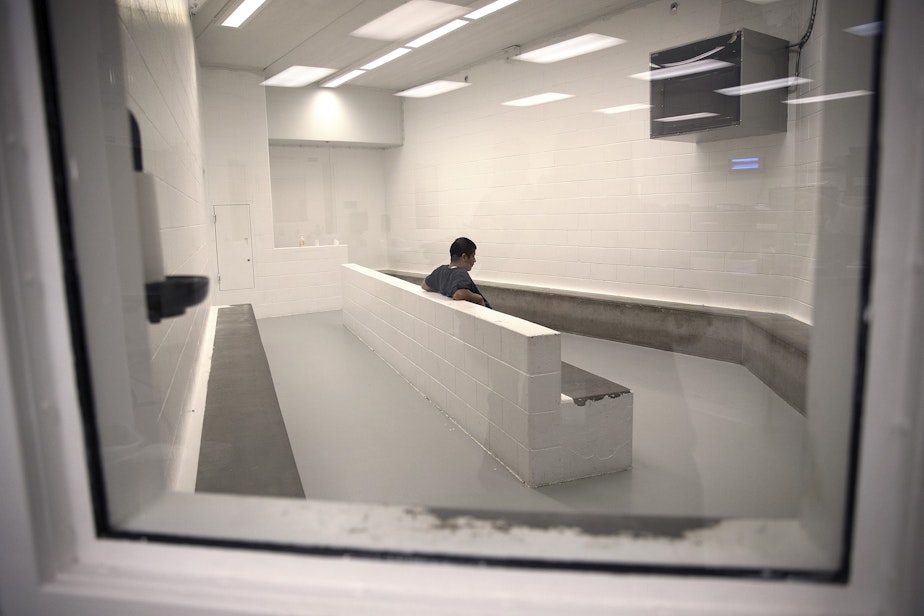
“When we arrived at the detention center, we started to talk to the other people," Espinoza said. “Some people had been there for 11 months, four months, six months...they said that there were no bail options, that nobody would be getting out — so the way out appeared to be to sign for a voluntary departure.”
Voluntary departure is a way for someone to avoid a deportation on their record, but they typically have to pay for the flight themselves.
RELATED: Under Trump’s ICE, people without criminal history increasingly targeted in WA
KUOW is not using Espinoza’s full name because she is worried about potential consequences for her ongoing immigration case. But she said she is sharing her story because others are in a similar situation, often without family or legal support.
Sponsored
“I think the most difficult thing for me, and for everybody, was the feeling of being locked up without any communication,” she said.
In Tacoma, and nationwide, roughly half the people in detention are in ICE custody due to civil violations of immigration law. Seventy percent of detainees there have no criminal history.
A wedding postponed
Espinoza, 52, is originally from a small town in Sinaloa, Mexico. She came to Seattle 20 years ago on a tourist visa to visit her brothers and felt safe in a way that never seemed possible in Sinaloa. Because she's gay, she said she faced discrimination most of her life back home, a place known for violence and cartel activity.
Xiomara Urán, an immigration an attorney with the Northwest Immigrant Rights Project, took up Espinoza’s case in detention and set an idea in motion: What if Espinoza and her partner went ahead with the marriage – but in detention?
Sponsored
Urán was hopeful the marriage would give Espinoza a better chance for bond, to get out of detention and continue fighting her case. But she also worried about red tape and delays to get the ceremony approved in time. Guards at the Tacoma facility were telling Urán and other attorneys about staffing shortages as the center filled to capacity.
ICE and GEO Group, the contractor that operates the facility, declined multiple requests to comment for this story.
Urán has worked exclusively with detained clients in Tacoma since 2020. She and her colleagues began to notice shifts in the operations there after Trump returned to office in January.
“The speed at which we're seeing the changes now – it's insane,” Urán said. “They’ve gone so fast.”
An initial blow for attorneys like Urán came in January, when the federal government cut funds for a longstanding legal orientation program at detention centers, including in Tacoma. Urán said program cuts led to logjams where attorneys would end up waiting a full day to see a client.
Sponsored
“They used to reserve three rooms for us, now they don’t,” Urán said, referring to attorney rooms. “So now, if you go at 10 a.m. or 11 a.m. you're probably going to wait between three and five hours before you can see anyone.”
Only about 14 percent of people in detention can find or afford an attorney, and those who do are 10 times more likely to win their case, according to government data.

With the legal orientations gone, Urán said detainees have heard discouraging messages from staff inside about access to counsel.
“They've told people that we have disappeared, [so] what's the point of fighting?" she said. "Because there's no one to fight for you. So just ask for your removal, or like self deport now.”
Sponsored
As Urán started to work on Espinoza’s case, sometimes Espinoza would sink into depression and talk about giving up, as conditions inside detention wore on her. Urán kept encouraging her to fight.
The detention center fills up
Inside detention, Espinoza said she slept poorly at night because some lights stayed on, and heavy doors slammed as the cleaning or kitchen crews moved through the halls. When her unit got time in the outdoor yard, sometimes she would stay in the dormitory area just for a bit of quiet or she would play basketball in a smaller courtyard.
“At the beginning, I didn’t understand why people slept a lot during the day,” she said. “Then later I understood it was a way of making sure that time went by quickly.”
Espinoza also worried about her health. She has stage four kidney disease and said she lost about seven pounds during her first weeks in detention, trying to avoid high-sodium foods. She usually felt cold.
The women who’d been detained for months told her everything was running slower than usual because there wasn’t enough staff to move them place to place. Several detainees KUOW recently interviewed also complained about a lack of outdoor time, meals that arrived hours late, and long waits for health care.
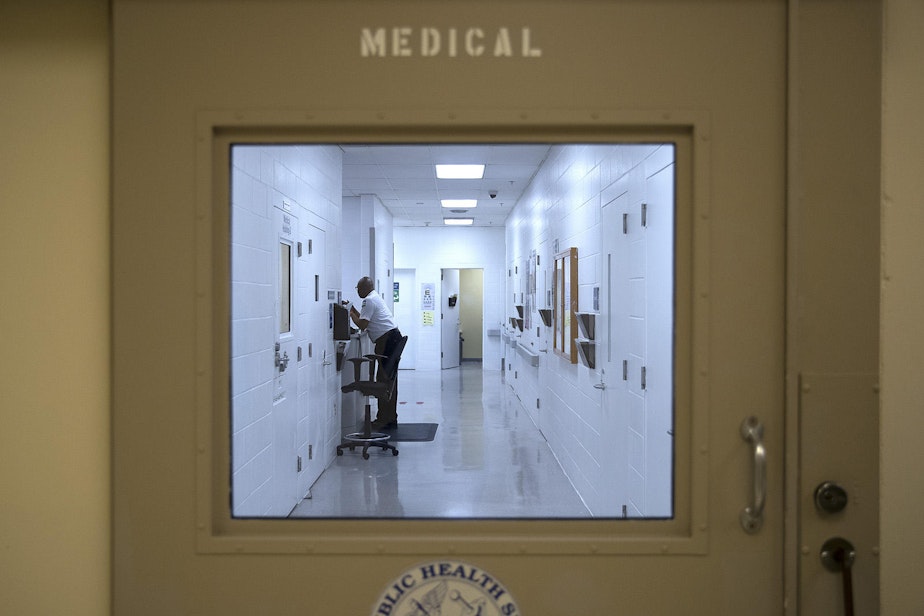
Around the country, congress members have stepped up visits to ICE detention centers and called for more transparency -- especially as places hit capacity.
“They have a number of staff openings that are unfilled that give me concern,” said U.S. Representative Emily Randall after an August visit to the Tacoma facility, which is in her district. “Lots of folks have said that they're unable to get outside, given the number of shifts for outdoor recreation.”
The daily population inside the Northwest ICE Processing Center has risen from 801 people on January 20, 2025, to slightly above its capacity of 1,575 in early June, according to ICE data analyzed by the University of Washington Center for Human Rights and the Deportation Data Project.
The August visit was Randall’s third this year. Health care is another concern she’s monitoring. She gave credit to the medical staff inside that provide care, although detainees continue to tell her about long delays.
“A lot of folks are just deciding not to keep showing up, not to keep trying not to even file complaints for a lack of access to care,” she said.
“And that demoralization, I think, can have really negative outcomes for individuals, for their physical health, for their mental health. And we're seeing more and more people who are signing to, like, self-deport because they don't have any fight left in them.”
RELATED: Washington farmworker who led union efforts talks life after ICE detention, returning to Mexico
Randall, a member of the U.S. House Oversight Committee, said she plans to keep up these visits because “it's important for the staff and detainees to know that Congress is watching.”
GEO Group has long maintained that it follows national detention standards and is committed to providing the highest quality services possible.
The immigrant advocacy group La Resistencia has been tracking some of these same concerns about healthcare and living conditions in the Tacoma facility for years. Rufina Reyes, the group’s director, said they now can receive up to 100 calls a day from detainees in Tacoma.
She flagged a pattern of detainees getting transferred farther away after publicly sharing complaints with her group, including a group of men transferred to Alaska in June. GEO Group and ICE did not respond to KUOW’s questions about transfers.

Other minor logistics can also create barriers for detainees to stay in contact with family, lawyers or support networks.
On a Saturday in July, Sister Mary Ellen Robinson, a Catholic nun, drove three hours from Wapato to visit a young man in detention from her community.
"He's part of a large family that needed to leave Mexico because their lives were in danger,” she said. "His family are very worried about him, and they are totally afraid to come anywhere near here.”
Outside the detention gates, Sister Mary Ellen and another woman from Ethiopia with a nephew inside compared copies of the daily visiting schedule. It showed a detailed system of odd and even days for each unit, but the schedule on ICE’s website was different than the paper version at the check-in desk. Neither woman was able to do their planned visit that morning – they came at the wrong time.
Waiting to marry, as a court deadline approaches
Urán filed paperwork with ICE to get the marriage approved, with support from the office of Congressmember Pramila Jayapal, who had met Espinoza during a visit at the detention center. Urán had no idea if the response from ICE would come in days or weeks or longer.
Meanwhile, Espinoza attended her first two hearings at the court inside the detention center, where each time she asked the judge for more time to prepare her case. After the second hearing, Judge John Odell told her they would need to proceed with her case at her next hearing, in early July.
Ten days before her hearing date, Urán received the wedding approval. Espinoza and G set the date, again, for a Saturday.
Espinoza’s fiancée arrived at the detention center that morning in a white pant suit, her long brown hair down past her shoulder. G's teenage son, Espinoza’s brother and nephew, and a family friend also joined them.
The ceremony lasted about 20 minutes, then G walked out, clearly trying to keep up a smile.
“I have like two emotions, like feeling excited because it was a special day for us but also sad because it’s not the place that we wanted or the way we wanted,” G said.

Until that day, all their visits for the past seven weeks had been behind a glass window, talking through a phone on the wall.
“Just to be able to hug each other, that's the moment that my heart was like…it was very emotional,” she said, no longer able to hold back her tears.
She was also encouraged to see Espinoza in better spirits after many weeks of seeing her scared and stressed.
After they exchanged rings, it caught them both off guard when the officiant asked if they wanted to share personal vows — they didn’t think they’d have a chance to speak here.
“I said something like this is like a test for us,” G said. “And I know that after this we are going to always be together and keep going.”
Urán, their attorney, seemed hopeful this marriage would give Espinoza a better chance to be released and continue her case outside of detention.
“I can never say that things are going be smooth because immigration court is always difficult, particularly in the detainee setting, and so the plan is now to get her out through a bond,” Urán said.
But bond is just one step toward freedom because even if Espinoza gets out, she’ll still have to fight to stay in the U.S. For people in deportation proceedings, like Espinoza, there can be a higher bar to prove it’s a bonafide marriage and qualify for a green card.
New restriction to get released on bond
In the past few years, the Tacoma immigration court has become known as one of the strictest in the country for bond approvals. The Northwest Immigrant Rights Project filed a class-action lawsuit in March, challenging a recent practice in Tacoma that resulted in bond denials for a whole class of detainees previously eligible for release. Since 2023, the lawsuit argued, the Tacoma court adopted a “unique” and “draconian” policy to deny bond requests by noncitizens who entered the U.S. without inspection, including those who have lived here for decades.
In September, a federal judge found the Tacoma bond policy unlawful but judges there have not changed course, according to The Seattle Times. In her ruling, U.S. District Judge Tiffany Cartwright noted that Tacoma immigration judges granted only three percent of bond requests in fiscal year 2023, making its rate “the lowest among immigration courts” during that period.
RELATED: Filipina green card holder and UW worker released from Tacoma ICE
This summer, the Trump administration also implemented a national policy that follows Tacoma’s model, calling for mandatory detention for far more immigrants. This national policy change is also facing a court challenge.
ICE Acting Director Todd Lyons described the new policy to Fox News as a way to more efficiently process immigration cases.
“We saw so many people that were apprehended illegally coming through the border and then using the bond system just to go ahead and be released out into the community, to have a court date in, you know, 2037, 2035, and never show up for court,” Lyons said.
Attorney Xiomara Urán has watched all these recent shifts in detention build on each other — the access to attorneys, to bonds, detainees transferred far from home -- and she sees it all leading to a much tougher fight for anyone who wants to stay here.
On the day of Espinoza’s bond hearing, she returned to Judge Odell’s courtroom. Family members lined the wood benches behind her.
Espinoza sat in front facing the judge, wearing a yellow uniform with a sweatshirt layered underneath. Her new wife gripped a legal folder in her hand, her son close at her side. She kept her eyes trained forward, occasionally darting a worried glance at her sister-in-law or niece.
Judge Odell evaluated Espinoza’s case, including her likelihood to show up for future court dates. He also reviewed whether she posed any risk to the community, noting a conviction for driving under the influence in 2009, for which she served one day in jail since it was a first offense. Odell found she met the bar for bond and set the amount at $3,500, on the lower end. Espinoza turned to her family as she left court, pushing a tear off her cheek.
'It's difficult to think of starting over'
After 52 days in detention, Espinoza returned home to her wife and teenage son and put her focus on her health, her legal case and her family life.
“It's difficult for me to think about starting over,” she said in Spanish. “We are together the three of us always.”
Her freedom came with the unexpected burden of an electronic ankle monitor, even though Judge Odell granted her bond with no conditions, including no monitor. Perplexed, her attorney Xiomara Urán appealed the monitor to Judge Odell and he lowered the bond amount to $1,500. Urán would later realize the confusion likely stemmed from a ICE policy change in July to expand the use of these monitors.

The monitoring calls would wake Espinoza in the middle of the night, asking for her location. “I’m in bed sleeping,” she’d tell them. In public, she’d keep it hidden.
She’s happy to be married, and chafes at the question about why the couple didn’t marry years ago, as a way to protect Espinoza from deportation.
“A marriage is not just a piece of paper and that’s it,” she said. “[You] have to do it for love, not just for convenience.
RELATED: ICE arrests 17 in raid at Kent specialty beverage company
Espinoza is hopeful she’ll be able to get a work permit while her immigration case is pending but that can take months to get approved. She enjoyed her two decades at Eagle Beverage, where she fixed broken machines. She sees something broken with the way ICE targets workers like her, in an economy that often relies on them.
“I think there are many good people who all they want is to get ahead,” she said. “In spite of everything that's going on, this is a hope that many people have.”
Looking back, she said the time in detention left her feeling like a different person.
“I think very much so, more than anything mentally, because basically, in reality, everything happened that I didn't want to have happen to me,” she said, her voice choked with emotion.

Espinoza seemed a little surprised by her own emotion. She’s private, reserved. She likes to be a steady anchor for her family.
A picture frame hangs above their dining room table displaying a simple, two-word mantra for this home: “family forever.”
Nationwide, immigration detention is reaching record highs, with an average of roughly 60,000 people held each day.
The massive bill President Trump signed in July quadruples the funding for detention, to keep expanding in the years ahead. White House officials call the bill’s increased funding for immigration enforcement a "once in a generation opportunity."
Credits
Story: Liz Jones
Editors: Isolde Raftery and Marshall Eisen
Sound design and mix: Hans Twite
Music composed by BC Campbell and Diana Meredith provided interpretation.
-
Liz Jones

Editor
Liz Jones is an editor for daily news, features and special projects. She started at KUOW in 2005 and worked primarily as a reporter until 2018. Her coverage largely focused on immigration and underrepresented communities.
More stories from Liz Jones »


